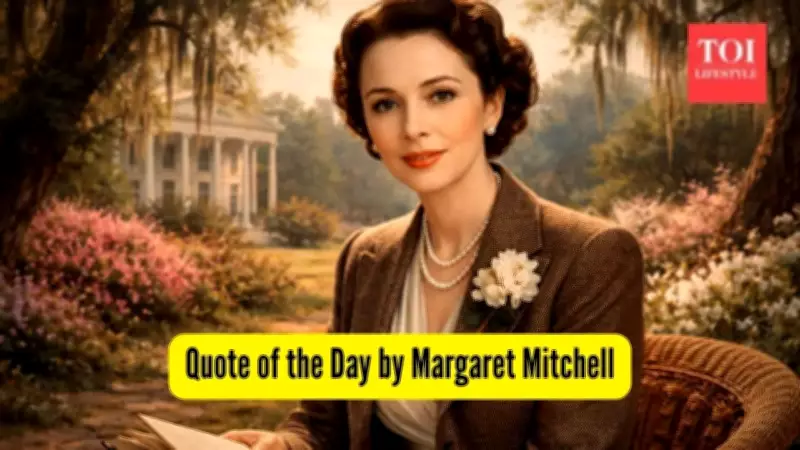
Margaret Mitchell: The Enduring Legacy of a 'One-Book Wonder'
Margaret Mitchell has frequently been labeled a 'one-book wonder' throughout literary history, a title that stems from her publication of just a single novel during her lifetime. However, the immense and lasting fame that this solitary work bestowed upon her continues to resonate powerfully even in the modern era. Her iconic masterpiece, Gone with the Wind, has exerted a profound and enduring influence on both literature and popular culture, cementing her status as a legendary figure in American letters.
Early Life and Influences
Margaret Munnerlyn Mitchell was born in Atlanta in the year 1900, into a family deeply engaged with the social and historical fabric of the American South. Her mother was an active advocate for social justice causes, including the pivotal women's suffrage movement, while her father practiced law and pursued historical scholarship. From a very young age, Mitchell was immersed in vivid narratives about the American Civil War and the tumultuous Reconstruction period that followed. These stories, often recounted by family members who had personally lived through those transformative times, profoundly shaped her imagination and would later become the foundational bedrock for her literary endeavors.
Education and Career Path
Mitchell initially pursued higher education at Smith College but was unable to complete her degree due to the tragic death of her mother, which necessitated her return to Atlanta. She subsequently embarked on a career as a reporter for the Atlanta Journal, where she honed her writing skills and developed a keen eye for narrative detail. Unfortunately, a physical injury forced her to leave this position, leading her to dedicate her energies fully to a secretive and deeply personal project.

The Creation of a Masterpiece
Margaret Mitchell devoted nearly a decade to writing Gone with the Wind, laboring mostly in secrecy and without any initial intention of publication. The novel was finally released in 1936 and swiftly achieved monumental success, captivating readers across the nation. In 1937, it was awarded the prestigious Pulitzer Prize for Fiction, solidifying its place as a literary phenomenon. Set against the backdrop of the American Civil War and its aftermath, the epic narrative follows the indomitable Scarlett O'Hara, a strong-willed Southern woman grappling with survival and adaptation in a rapidly changing world. The book masterfully explores universal themes of love, loss, resilience, and transformation, while also providing a nuanced portrayal of the social and economic upheavals experienced by the South during Reconstruction.
Literary Impact and Style
The 1939 film adaptation of Gone with the Wind further amplified its popularity, elevating it to become one of the most celebrated and iconic movies in cinematic history. Margaret Mitchell's writing is renowned for its exceptional character development, emotional depth, and vivid, immersive storytelling. A hallmark of her talent is the creation of characters who are both deeply memorable and intricately complex. Scarlett O'Hara, for instance, is portrayed with significant imperfections, making her a multifaceted and realistic figure. Mitchell's characters consistently exhibit authenticity and dimensionality, which fosters a powerful connection with readers.
Another critical aspect of her literary style is the meticulous incorporation of historical detail. Mitchell expertly reconstructs the era of the Civil War and Reconstruction by weaving factual events with fictional narratives, achieving a remarkable level of authenticity that transports readers back in time. Her adept use of dialogue effectively reveals character traits and propels the story forward, while her strong sense of place—particularly her focus on the American South—adds richness and uniqueness to her work.
Later Life and Legacy
Following the unprecedented success of her novel, Margaret Mitchell led a relatively private life. Despite widespread anticipation that she would produce another literary work, she never published a second book. Her life was tragically cut short in 1949 when she was struck by a car in Atlanta. Nevertheless, she had already secured a permanent and influential literary legacy.

Today, Margaret Mitchell is remembered as a singular author whose one monumental book made an indelible impact on the world of literature. Her ability to capture the complexities of human experience within a specific historical context ensures that Gone with the Wind remains a timeless and essential read, continuing to inspire and engage audiences across generations.