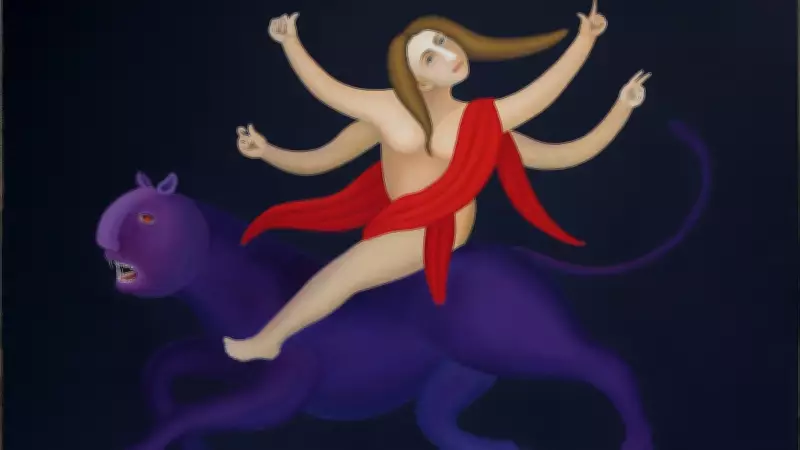
Vadehra Art Gallery Presents 'The Storyteller': A Tribute to Manjit Bawa's Artistic Legacy
Vadehra Art Gallery's Defence Colony space in New Delhi is currently hosting a captivating solo exhibition titled 'The Storyteller,' dedicated to the works of the late modernist painter Manjit Bawa. The exhibition, which opened on January 28 and will run until March 2, 2026, brings together a remarkable collection of 10 large canvases and 18 works on paper, showcasing Bawa's mastery across various mediums including oil paintings, charcoal, pastel, ink, and tempera. All pieces are drawn from the personal collection of his children, Bhavna and Ravi Bawa, offering an intimate glimpse into the artist's creative world.
Shashi Tharoor's Insights on Bawa's Artistic Philosophy
At the exhibition's opening, politician and writer Shashi Tharoor addressed the gathering, urging attendees to engage with Bawa's paintings with patience and without haste. He emphasized that art should not be rushed or decoded for quick conclusions, stating, 'Art does not present conclusions.' Tharoor highlighted the aptness of the exhibition's title, noting that storytelling is humanity's primal way of making sense of the world, a theme deeply embedded in Bawa's work.
Manjit Bawa: A Brief Biography and Artistic Journey
Born in 1941 in Dhuri, Punjab, Manjit Bawa received his formal training at the School of Art, Delhi Polytechnic, earning a national diploma in fine arts in 1963. He further honed his skills with a diploma in silk screen painting from the Warden Institute of Essex in England in 1967. After working as a serigrapher in London and briefly teaching painting in England, Bawa returned to India, where he became a prominent figure in the art scene. His career was marked by participation in major art camps both in India and abroad, and he co-founded Sama'a with Ina Puri in 1998 to support artists. Bawa's contributions were recognized with the National Award from the Lalit Kala Akademi in 1980, and he passed away in 2008, leaving behind a rich artistic legacy.

Exploring Myth and Form in Bawa's Works
The exhibition 'The Storyteller' delves into how Bawa perceived myth as a living, evolving narrative rather than a fixed scripture. His paintings feature recognizable figures of gods, humans, and animals, characterized by curved and merging limbs that avoid sharp edges, creating a sense of visual gentleness and steadiness. Tharoor described this quality as 'visual gentleness without fragility,' where intensity is held in check, allowing for a harmonious coexistence of emotions within the same frame.
In one notable untitled work, Bawa depicts a man holding a knife with his daughter seated on his knees—a scene laden with potential violence that is not dramatized. This reflects Bawa's belief that joy and sorrow, devotion and anxiety can coexist, with harmony defined by the ability to remain present within these contrasts, not by their absence.
Bawa's Engagement with Mythology and Artistic Freedom
Art conservator and writer Rupika Chawla, in her exhibition note, recalls Bawa as an artist deeply influenced by theatre, oral traditions, and regional variations of myths. She notes that while core stories remained intact, Bawa embraced the subtle shifts in details, justifying an artist's freedom to 'play around with the imagery' while allowing the myth itself to endure. This freedom is evident in works like his depiction of Narasimha killing Hiranyakashipu, where violence is suggested through a charged red background rather than explicit gore.
Personal Influences and Emotional Depth
The exhibition also sheds light on the personal history that shaped Bawa's art. In a heartfelt note, his daughter Bhavna Bawa remembers her father as playful, gentle, and instinctively compassionate. She shares how caring for her brother Ravi, who has special needs, profoundly influenced Bawa's visual world, leading to paintings where forms merge without harsh divisions. Bhavna writes, 'Though many people touched his life, none shaped it as deeply as Ravi.' This personal touch adds emotional depth to the exhibition, revealing the human stories behind the art.

Conclusion: The Enduring Power of Bawa's Art
Manjit Bawa's paintings do not seek to explain; instead, they trust the viewer to engage and interpret. Many of his works remain untitled by design, inviting audiences to uncover meanings at their own pace. As Tharoor reminded, a good story does not disclose everything at once—it waits for its audience to take part. 'The Storyteller' at Vadehra Art Gallery is a testament to Bawa's enduring dialogue with myth and form, offering a unique opportunity to experience his artistic vision in the heart of Delhi.