DON'T let Amma take too much cut! That warning accompanied every trip to the bhatti, though none of us had the faintest idea how much grain was deducted for roasting. The cut was a mystery. The excitement was not. The bhatti stood in the heart of the town market, between a halwai's shop fragrant with jalebis and a provision store stacked with colourful tins. You could locate it easily — a ribbon of smoke curled into the sky, carrying the comforting aroma of roasting grains.
The bhatti was the unofficial headquarters of our childhood. When cousins arrived during vacations, a trip to the bhatti was a must. Mother would fill a round steel dabba with a few fistfuls of makki. It felt precious. Off we marched through the market's merry mayhem. Vendors advertised vegetables. Rickshaw bells rang. Scooters sputtered. Shopkeepers exchanged neighbourhood news snippets. Amidst this bustle stood the bhatti, glowing and crackling like a tiny sun.
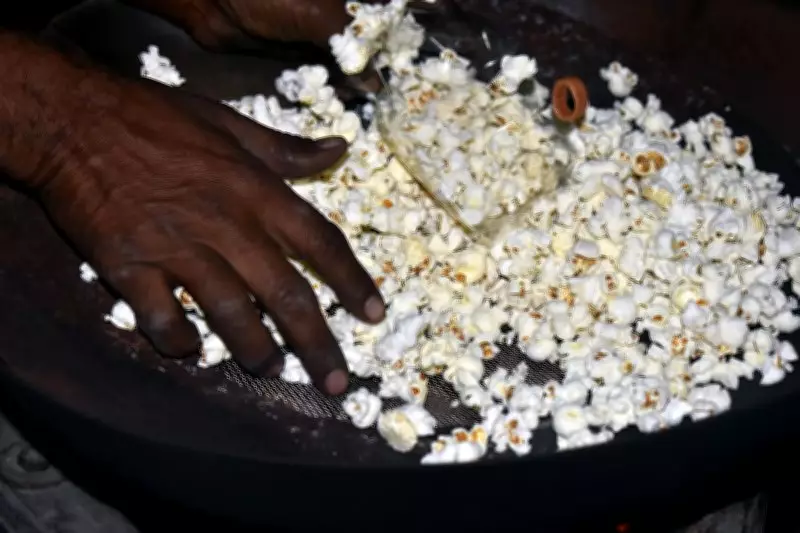
Presiding over it was an elderly woman we called Amma. Her silver hair was tucked beneath the edge of her sari. Her bangles chimed softly as she worked. With practised precision, she stirred hot sand in a large iron pan. Then came the transformation. The grains danced. The maize twirled. The chana crackled. Kernels blossomed into fragrant treasures. We watched, spellbound.

One afternoon, determined to prove my importance, I insisted on carrying the dabba myself. I walked ahead of everyone with exaggerated responsibility. The market, however, had other plans. The dabba slipped from my hand. The lid rolled away with a metallic clatter and a shower of makki scattered across the stone-paved lane. For a moment, my heart stopped. Then began the rescue mission. I crouched down and started collecting kernels one by one. A shopkeeper pointed towards a few that had escaped beneath his stool. My cousins, meanwhile, contributed absolutely nothing except commentary: “You missed one.” “No, two.” “Look behind you.” By the time every kernel had been recovered, I was dusty, flustered and convinced I had saved the family fortune. We narrated the incident to Amma. She remarked, “Good. Now even the pigeons know the new crop has arrived.”
The roasting itself was a ritual. We crowded around Amma, issuing instructions: “Mine first!” “Don't over-roast it!” “And don't take too much cut!” She would merely smile. When the roasted grain was weighed, we watched the scales with suspicion. Yet the moment warm, smoky handfuls reached our palms, all disputes vanished.
Today, popcorn arrives packed in glossy packets and baskets. It is quicker, cleaner and more convenient. But convenience has replaced community. The crackle remains, yet the charm is gone. No Amma. No cousins. No smoky afternoons. No anxious eyes fixed on the scales. And no delicious debate about cut. I still don't know how much grain Amma deducted. But I know this: not a single grain of joy was ever lost. Those bhatti days remain fragrant, fire-kissed and glowing in memory.
The author is VP, Kamal Encon Industries, Yamunanagar.