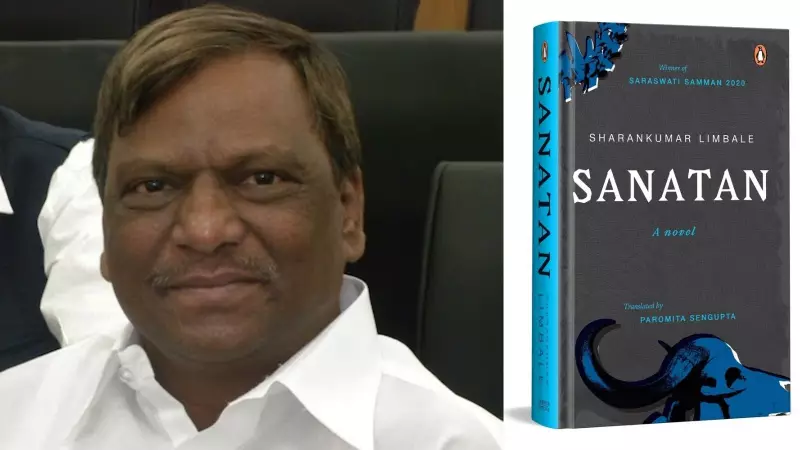
Veteran Marathi writer Sharankumar Limbale's powerful novel, Sanatan, translated into English by Paromita Sengupta, stands as a monumental work in modern Dalit literature. Moving beyond the autobiographical impulse of his earlier work, Akkarmashi, Limbale crafts a generational archive that transforms personal memory into a collective testimony of dispossession and resilience.
The Unchanging Geography of Oppression
The narrative begins in the Maharwada, the segregated settlement for Dalits situated on the outskirts of a village yet bound to its service. The novel opens with a stark, harrowing scene: members of the Mahar community gathering around a dead cow's carcass, a rare source of sustenance. This fleeting moment of hope is brutally crushed when upper-caste villagers accuse them of killing the animal and unleash violence. Limbale presents this not with melodrama, but with raw, documentary-like clarity, highlighting how survival itself is criminalized.
Through the lives of characters like Bhimnak Mahar and Sidnak Mahar, the story spans critical historical moments. It traces the Mahar community's recruitment into British colonial armies, their marginal role in the 1857 revolt, and their eventual politicization under the guidance of B.R. Ambedkar. Yet, the central, devastating truth the novel reveals is that each generation inherits not progress, but the same entrenched stigma. The village's oppressive geography—the well they cannot use, the temple doors that remain shut—forms a constant, unchanging backdrop.

Eternity as a Curse, Not a Divine Order
The title, Sanatan, performs a profound and ironic reversal. Traditionally, Sanatan Dharma refers to the eternal, moral order of Hindu society. In Limbale's vision, the only thing that is eternal is the permanence of the caste hierarchy. Caste persists like a geological layer across centuries, unaffected by historical change or personal struggle.
This is reflected in the novel's very structure. It resists a conventional linear narrative or a central protagonist, aligning with Limbale's theoretical stance in Towards an Aesthetic of Dalit Literature, where he argues that Dalit writing emerges from a collective "we" rather than an individual "I". The book functions as a collective chronicle, giving voice to a community historically denied the right to narrate itself.
The False Promise of Escape and a Distinct Dalit Ecology
The novel meticulously interrogates the idea of religious conversion as an escape route. The character Sidnak Mahar, who converts to Christianity and becomes Philip Bush, discovers that caste shadows him into the church, replicating the discrimination he sought to leave behind. Similar disillusionment meets those who turn to Islam or Buddhism. Conversion offers only a temporary, fragile hope, failing to dissolve the fundamental hierarchy.
In conversation, Limbale articulated this separation through the concept of a "Dalit ecology"—a distinct world defined by its own arrangement of space, suffering, language, and culture. Sanatan vividly portrays this ecology, insisting that even air, water, and sound are distributed along caste lines. Pollution here is not a metaphor but a lived condition, a fate imposed from birth to death.
The tone that emerges from this reality is one of philosophical endurance, not resignation. It is the weary understanding that revolt alone cannot dismantle a structure sanctified as eternal. Sanatan does not offer easy uplift or promise emancipation. Instead, it does something more rigorous: it compels recognition. It holds up the mirror to the idea of the sanatan to reveal what Indian society has chosen to make eternal—systemic oppression.
Reflecting on the present, Limbale's concluding words resonate with chilling relevance: "Even now, caste persists in its brutal form… Society may build new spaces, but caste has developed into even more terrifying forms." In this light, Sanatan becomes the ultimate indictment of its own title—a narrative that refuses to let cruelty masquerade as tradition.