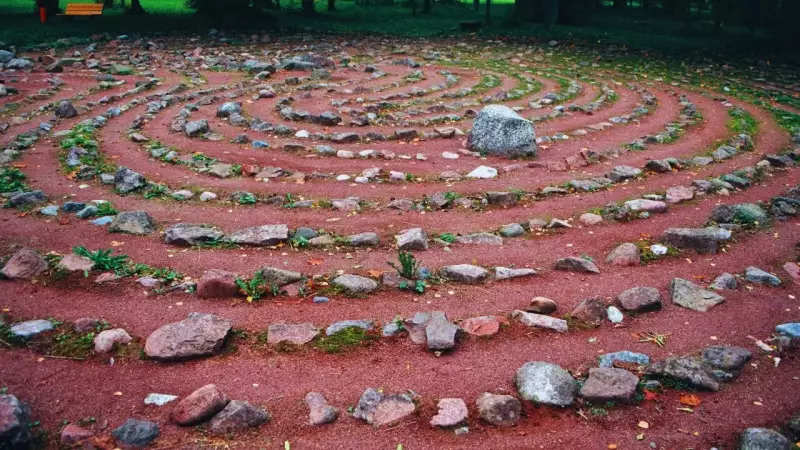
In a groundbreaking archaeological find that is set to redefine the historical narrative of ancient India's commercial links, researchers have confirmed the discovery of the country's largest circular stone labyrinth. This monumental structure, hidden for centuries, was found in the Boramani grasslands of Solapur district, Maharashtra.
An Accidental Discovery by Wildlife Watchers
The labyrinth was not initially found by archaeologists but by members of the Nature Conservation Circle, a local NGO. While tracking the critically endangered Great Indian Bustard and native wolves in the Boramani grassland safari sanctuary, the team noticed an unusual circular stone formation partly concealed by grass and soil. This serendipitous find during a wildlife monitoring mission highlights an unexpected convergence of ecological conservation and heritage preservation.
The structure is immense, measuring roughly 50 feet by 50 feet. Its most astonishing feature is that it comprises 15 concentric stone circuits, meticulously built using small, arranged stone blocks. These pathways gradually wind inward to a central spiral. Analysis of soil deposits—about 1.5 inches thick between the stone rings—indicates the labyrinth has lain largely undisturbed for nearly two millennia.

Why This Labyrinth is a Record-Breaker
This discovery shatters previous archaeological records for India. Prior to this, the known circular labyrinths in the country had a maximum of 11 circuits. The Boramani structure, with its 15 circuits, now holds the title of the largest circular stone labyrinth ever found in India. While a larger square-shaped labyrinth exists in Gedimedu, Tamil Nadu, the Solapur find is unparalleled in its circular design and complexity.
The Boramani grasslands are located approximately 20 kilometres southwest of Solapur city. This semi-arid region, with its rolling terrain and seasonal vegetation, serves as a vital habitat for wolves, blackbucks, and migratory birds. Its status as a protected grassland safari zone is likely what shielded the ancient monument from human interference, allowing it to survive intact for centuries.
A Link to the Satavahana Dynasty and Global Trade
Archaeologists have dated the labyrinth to around 2,000 years ago, placing it firmly within the era of the Satavahana dynasty (1st to 3rd centuries CE). This period was marked by flourishing long-distance trade between India and the Roman Empire, with Maharashtra's Deccan region acting as a crucial hub.
Intriguingly, the labyrinth's design bears a close resemblance to patterns found on ancient coins from Crete, which circulated as Roman currency in Indian ports and trading centres. Furthermore, the discovery of similar, though smaller, labyrinths in Sangli, Satara, and Kolhapur districts suggests a wider network of ancient trade routes across the region.
Experts theorize that these structures may have functioned as navigational markers or symbolic signposts for Roman merchants venturing inland from Maharashtra's western coast. Its location in an open grassland, away from any major settlement or temple, adds to the mystery of its precise ritual or practical use.
This remarkable find underscores Maharashtra's role as a vital crossroads in global commerce nearly two millennia ago. It also presents a new challenge: ensuring that future archaeological exploration protects the fragile grassland ecosystem that has been its guardian for so long.