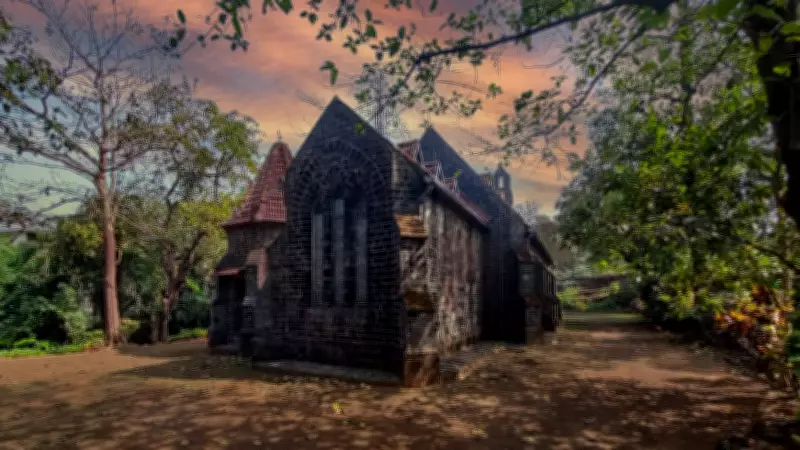
Historic Khandala Chapel Reborn as Abbey 301, Maharashtra's New Cultural Sanctuary
Nestled in the serene Sahyadri Hills between Mumbai and Pune, a 200-year-old black basalt chapel has been given a new lease on life. After careful restoration with minimal intervention, this Gothic structure has reopened as Abbey 301, Maharashtra's newest and most intimate cultural venue dedicated to music, poetry, theatre, and community creativity.
A Dream Realized Through Generations
The chapel's transformation represents the fulfillment of a long-held family vision. "We've had this beautiful Gothic structure in our family for almost six decades. My father-in-law, Bhagwanbhai Kotak, bought it from the outgoing Anglican church when they were leaving India. It was the love of my father-in-law's life as it brought him great joy," reveals Kamini Kotak, promoter of the project and member of Abbey 301's steering committee.
Bhagwanbhai Kotak had dreamed of turning the chapel into either a place of contemplation or a library, given his collection of over 3,000 books. "He also felt that this would be a lovely place for music. That was one of the reasons we decided to turn it into a performing art space," adds Kamini Kotak, highlighting how the family's personal connection to the building guided its new purpose.

Conservation with Care and Consciousness
The restoration work, led by architect Adil Dholakia of Five Cross Architects, approached the historic building with reverence and precision. "The essence of this building is that it carries a lot of memories, as it is a colonial-era building. Our conservation approach respects the building's original structure, scale and architectural language, with contemporary interventions intentionally kept to a minimum," explains Dholakia.
The architectural team focused on essential enhancements only where necessary:
- Improved acoustics for musical performances
- Enhanced lighting while preserving stained glass windows
- Safety upgrades for public use
- Structural reinforcements for long-term sustainability
Vishakha Gangar, another architect on the team, emphasizes their environmental consciousness: "We were very conscious of the carbon footprint because when we are looking at conservation and an adaptive reuse of an old building. Whatever was salvaged was first consumed and, then, new materials were brought in."
A Launch Weekend Showcasing Artistic Excellence
The venue's inaugural weekend offered a compelling glimpse into its curatorial vision. The programming featured:
- Poet-lyricist Kausar Munir taking center stage on January 31 morning
- Singer-songwriter Nikhil D'Souza performing at 2 pm
- The Sanjay Divecha Trio enchanting audiences at 6:30 pm
- Grammy Award-winning bansuri maestro Rakesh Chaurasia performing at sunrise on Sunday
Complementing the musical performances, an outdoor exhibition of 32 ceramic sculptures by Bhopal-based contemporary artist G Reghu greeted visitors, remaining on display for several weeks to allow meaningful engagement with the artwork.
Building Community Through Creative Expression
Abbey 301 aims to become more than just a performance venue. "Community outreach is a large part of our work. The other side is that we hope that when we have artists performing here, we will be able to bring children who are interested and have talent to interact with them and get better exposure," shares Kamini Kotak, outlining plans to involve local communities, schools, and institutions for the aged and visually impaired.
Leading the creative programming are Pushan Kripalani and Xerxes Unvala, who bring decades of experience in filmmaking, theatre, music, and international cultural programming. Unvala describes Abbey 301 as "a holistic space for music, theatre, dance," while Kripalani draws a profound parallel: "A chapel is a place for people to congregate and share a unified experience. Is that exactly what a theatre is also? You are coming with whatever your personal background is and whatever you are going through at the moment. You are congregating with others for a unified experience, and what you will take away from the experience will be different from everyone else's."

A New Chapter in Maharashtra's Cultural Landscape
Named after the area's postal code, Abbey 301 stands as a testament to thoughtful heritage conservation meeting contemporary cultural needs. The black basalt walls, which once echoed with prayers and hymns, now provide a dramatic backdrop for artistic expression across multiple disciplines.
This transformation represents a significant addition to Maharashtra's cultural infrastructure, creating a unique intimate venue that bridges the geographical and cultural spaces between Mumbai and Pune. By preserving historical integrity while embracing new creative possibilities, Abbey 301 promises to become a cherished destination for artists and audiences seeking meaningful cultural experiences in a setting rich with history and natural beauty.