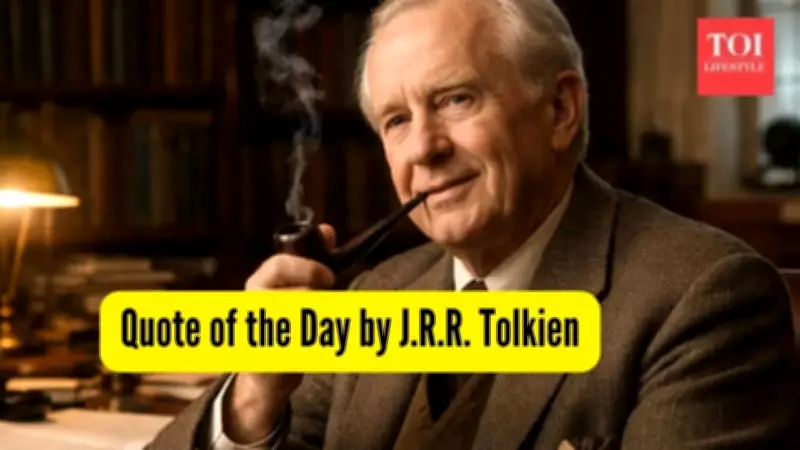
The Enduring Legacy of J.R.R. Tolkien: Architect of Modern Fantasy
J.R.R. Tolkien stands as one of the most influential literary figures of the 20th century, renowned for crafting an intricate fantasy universe that has captivated millions globally. Born John Ronald Reuel Tolkien in 1892 in Bloemfontein, South Africa, his early life was marked by profound loss. Following his father's death, his mother relocated the family to Birmingham, England, only for Tolkien to become orphaned at age 12 after her passing.
Early Influences and Academic Pursuits
Under the guardianship of Father Francis Morgan, Tolkien's education flourished, nurturing a lifelong fascination with languages. This passion led him to Oxford University, where he immersed himself in English language and literature. His academic journey was interrupted by service in the British Army during World War I, where he witnessed the horrors of battles like the Somme. These traumatic experiences profoundly shaped his writing, infusing it with themes of conflict, sacrifice, and the eternal struggle between good and evil.
The Birth of Middle-earth
Returning to academia, Tolkien became a distinguished professor at Oxford, specializing in Old and Middle English. His scholarly work was complemented by extraordinary creativity—he constructed entire languages like Elvish, complete with grammar and vocabulary. This linguistic innovation became the foundation for his fictional world, Middle-earth, setting his work apart from contemporaries.

Literary Masterpieces That Defined a Genre
Tolkien's breakthrough came with The Hobbit in 1937, initially conceived as a children's tale following the unexpected adventures of Bilbo Baggins. Its success prompted the epic sequel The Lord of the Rings, published between 1954 and 1955. This monumental work, set in the richly detailed Middle-earth, chronicles the quest to destroy a malevolent ring, exploring profound themes of friendship, courage, and resistance against darkness.
Signature Style and Mythological Foundations
Tolkien's writing is celebrated for its depth, meticulous world-building, and poetic descriptions of landscapes inspired by nature. His narrative voice, often formal and archaic, drew from ancient texts and legends. Crucially, he wove elements from Norse and Anglo-Saxon mythology into his stories, creating a timeless quality that resonates across generations. His characters, while heroic, are rendered with authentic human emotions—fear, doubt, and personal growth.
Cultural Impact and Lasting Influence
Tolkien's legacy extends far beyond literature, earning him the title father of modern high fantasy. His work established benchmarks for world-building and narrative complexity, inspiring countless authors and spawning entire subgenres. The cultural phenomenon expanded with Peter Jackson's acclaimed film adaptations of The Lord of the Rings, introducing Middle-earth to new audiences worldwide.
His influence permeates video games, art, and fan communities, while scholars continue to analyze his linguistic and literary contributions. Following his death in 1973, his son Christopher Tolkien posthumously published unfinished works like The Silmarillion, further enriching the mythology of Middle-earth.
A Timeless Message of Resilience
One of Tolkien's most enduring quotes from The Fellowship of the Ring encapsulates his philosophy: “Faithless is he that says farewell when the road darkens.” This powerful statement champions loyalty, courage, and perseverance through adversity. It reminds us that true character is revealed not in ease but in hardship, urging steadfastness when challenges arise.
Ultimately, J.R.R. Tolkien was more than an author—he was a visionary world-builder whose imagination, linguistic genius, and personal experiences created stories that transcend time. His works continue to inspire, entertain, and provoke thought, securing his place as a cornerstone of literary history.