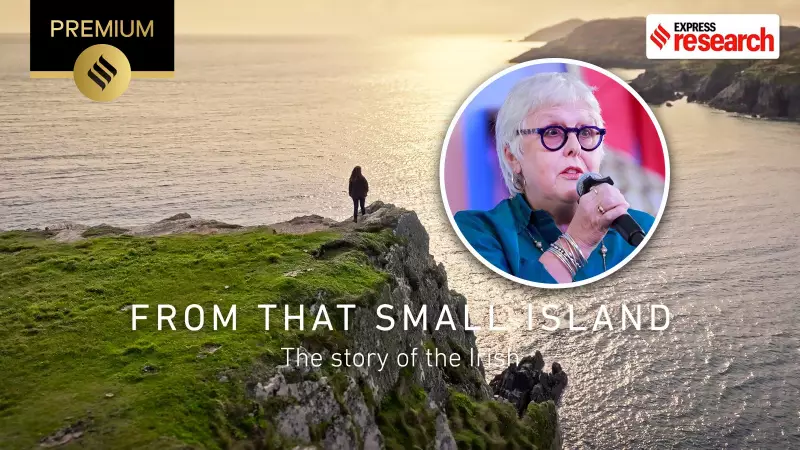
Ireland as Imperial Laboratory: Jane Ohlmeyer on Shared Histories with India
Historian Jane Ohlmeyer, a leading expert on early modern Ireland and empire, recently shared profound insights at the Jaipur Literature Festival, reflecting on the long and uneasy connections between Ireland and India under British rule. As a historical consultant for the documentary From That Small Island: The Story of the Irish, Ohlmeyer delves into Ireland's dual position as both colonised and complicit, shedding light on how imperial practices were transferred and why these shared histories remain relevant today.
The Centrality of the Ireland-India Connection
In an exclusive interview, Ohlmeyer emphasized that the relationship between Ireland and India spans over 400 years, dating back to the 17th century. She noted that while India was the largest colony, Ireland was one of the oldest, creating a complex imperial dynamic. The Irish were not merely victims of imperialism but also active participants, serving in various roles across the British Empire, including in India. This duality is a key theme in her work, highlighting how Irish communities spread globally by piggybacking on European powers like Britain, France, and Spain.
Ohlmeyer pointed out that Irish individuals in India often held positions of power, yet many were also subversives within the imperial system. Irish political experiences significantly influenced Indian resistance movements, particularly in Bengal, showcasing a shared legacy of struggle against colonial rule. The documentary, filmed in locations such as Mumbai, Delhi, and Kolkata, captures India's vibrancy through stunning cinematography, with a 90-minute feature version and a detailed four-part series.

Irish Involvement in British India: A Fraught History
By the 19th century, approximately two-thirds of the White soldiers in the British army in India were Irish, many of whom were Irish-Catholics treated similarly to indigenous sepoys. These soldiers were often barred from becoming officers, a role typically reserved for Anglo-Irish Protestants. Ohlmeyer explained that this involvement stemmed largely from economic desperation in Ireland, where lack of opportunity drove many to volunteer for the army, not out of ideological commitment but due to grinding poverty.
Ireland's role as a supplier of human capital extended beyond the military, with indentured servants sent to the Caribbean, making people its biggest historical export. This economic shaping, where Ireland provisioned England with food and labor, underscores the deep entanglements of empire.
Ireland as a Laboratory for Imperial Practices
Ohlmeyer highlighted that Ireland served as a testing ground for policies later adopted in India. Key areas include:
- Education: Curricula developed in Ireland were taught in India by the 19th century.
- Policing: Both regions employed coercive, armed policing models, with many trained in Dublin.
- Political Governance: Structures like viceroys and presidencies were refined in Ireland and exported to India.
- Personnel: Numerous bureaucrats serving in India were Irish or trained in Ireland.
This transfer of practices, Ohlmeyer argues, is a significant yet underdiscussed story, even in Ireland, where people often forget their country's role as an imperial laboratory.
Confronting Complicity: Cases Like Amritsar
Episodes such as the Amritsar massacre complicate Irish narratives of colonial victimhood. General Reginald Dyer, educated in Ireland, and Lieutenant-Governor Michael O'Dwyer, an Irish-Catholic from Tipperary, were key figures in this tragedy. Ohlmeyer stresses the importance of holistic historical storytelling, including these dark aspects without judgment. She warns against weaponizing history, advocating for multiple perspectives to understand complexity and nuance, as seen in contested artefacts like the Koh-i-Noor diamond.

Partition and Shared Legacies
The legislation that partitioned Ireland was later used to divide India and Pakistan, influencing other regions like Israel and Palestine. Ohlmeyer sees this as a testament to Ireland's role as an imperial laboratory but also offers hope. Ireland's current discussions on reunification might inspire other partitioned areas. Reflecting on her upbringing in Belfast during the Troubles, she notes Ireland's progress toward a more progressive and inclusive society, with reduced dominance of the Catholic Church.
Contemporary Issues: Indian Immigrants in Ireland
Addressing recent attacks against Indian immigrants, Ohlmeyer highlighted that about 20% of Ireland's population was born abroad, making it proportionally more diverse than the United States. The Indian community, numbering around 165,000 or 3% of the population, is well-assimilated and respected, contributing significantly to sectors like health and technology. While a minority resents newcomers, most Irish people embrace inclusivity, as evidenced by celebrations of Diwali and Holi and the large presence of Indian students in universities.
Ohlmeyer's insights underscore the enduring connections between Ireland and India, urging a nuanced understanding of history to foster empathy and progress in today's globalized world.