Hyderabad's Historic Monuments Face Critical Neglect Despite Government Budget Promises
While the Telangana state government prominently highlighted ongoing conservation and development works around the iconic Charminar and Laad Bazaar in its recent budget presentation, a stark reality persists in Hyderabad's Old City. Numerous historic structures, some dating back over four centuries, continue to languish in severe neglect, with heritage activists sounding urgent alarms about their deteriorating condition.
Monuments in Visible Disrepair and Advanced Decay
One of the most concerning examples is the Alawa Sartouq at Darul Shifa, a structure dating back to 1596 CE that once served as a renowned hospital approximately 400 years ago. This historic site now shows visible signs of disrepair, with its architectural integrity compromised by years of neglect.
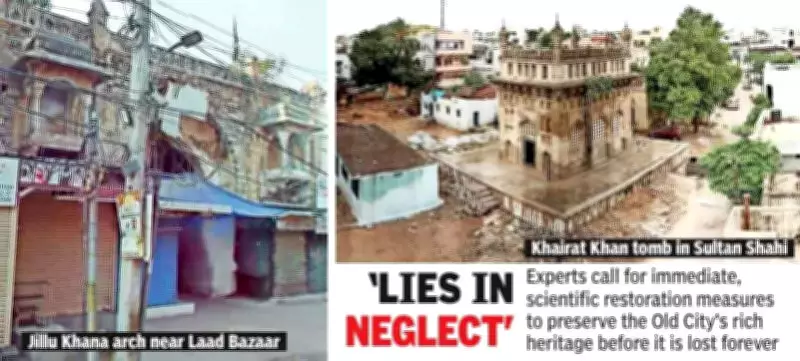
Equally troubling is the condition of the Jillu Khana arch near Laad Bazaar, a ceremonial gateway used during the Asaf Jahi era to welcome the Nizams. This architectural feature has lost significant portions of its plaster, exposing the vulnerable brick framework beneath and diminishing its historical grandeur.

"At Ananas Phatak, commonly known as the pineapple gate opposite Khilwat Palace, only the gateway structure survives today," explained Mubashir Khan, a prominent Hyderabad historian. "The distinctive pineapple finials that gave this gate its name are now severely damaged, representing a significant loss of architectural detail."
Multiple Heritage Sites at Risk of Permanent Loss
The Kaman of Shaikh Faiz in Dabeerpura, historically associated with the important Bibi ka Alam procession, has suffered extensive damage to its decorative elements. Much of the intricate stucco work that once adorned this structure has been lost, leaving behind a diminished version of what was once an architectural masterpiece.
Even more concerning are the tomb complex of Khairat Khan in Sultan Shahi and the twin tombs of Mir Qutubuddin Niamatullahi in Moghalpura. These sites have reached advanced stages of decay, with structural damage compounded by encroachments that pose serious risks to their preservation.
"Many of these heritage structures are literally on the verge of collapse, especially with the monsoon season approaching," warned Anuradha Reddy from INTACH Hyderabad. "Temporary patchwork repairs will not save them from permanent loss. We need comprehensive, scientific restoration measures implemented immediately."
Local Residents Voice Concerns About Cultural Identity
Residents of the Old City echo these preservation concerns, expressing frustration with what they perceive as reactive rather than proactive conservation efforts.
"We witness pieces falling off these historic structures every single year," said Mohammad A, a shopkeeper from Laad Bazaar. "Authorities typically only act after significant damage has already occurred. These monuments are integral to our cultural identity. If they disappear, a vital part of our shared history vanishes with them."
Heritage experts emphasize that immediate intervention is crucial to preserve the Old City's rich architectural legacy before irreversible damage occurs. The approaching monsoon season presents particular urgency, as increased rainfall could accelerate structural deterioration in already vulnerable monuments.
Institutional Response and Conservation Challenges
While officials from the Archaeological Survey of India (ASI) acknowledge that no major conservation projects have been undertaken recently for these structures, the State Archaeology Department has conducted only minor repairs that heritage activists consider insufficient.
An ASI official explained the current institutional approach: "In recent times, we have not carried out any major conservation works on these monuments, nor do we have active collaboration with the state archaeology department. When issues arise with monuments under our jurisdiction, we address them, but we have not received specific instructions from the government regarding these particular structures."

This institutional gap highlights the complex challenges facing heritage conservation in Hyderabad, where multiple agencies share responsibility but coordinated action remains elusive.
The Broader Implications for Hyderabad's Heritage
The neglect of these monuments represents more than just architectural loss. Each structure tells a story about Hyderabad's rich history, from its Qutb Shahi origins through the Asaf Jahi period. Their deterioration threatens to erase physical connections to the city's multicultural past and diminish its cultural tourism potential.
As heritage activists continue to document the declining condition of these sites, they call for a more systematic approach to conservation that prioritizes vulnerable structures before they reach the point of no return. The contrast between government budget announcements and on-ground reality underscores the need for more effective implementation of heritage preservation policies in one of India's most historically significant urban centers.