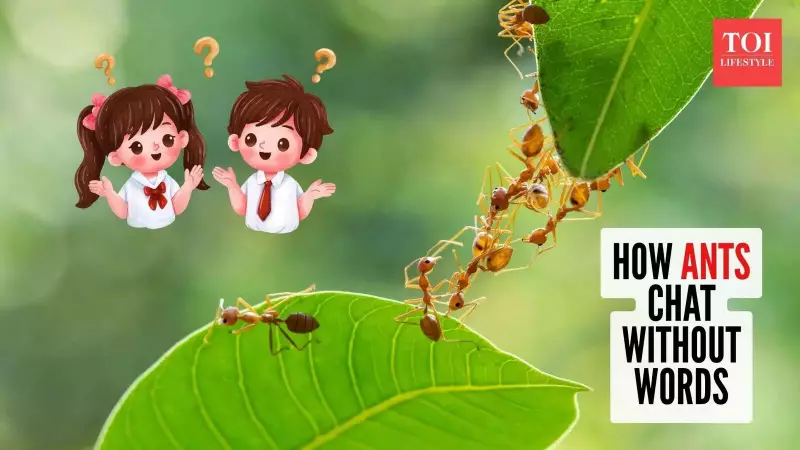
While humans rely heavily on vocal communication, ants have evolved a remarkably sophisticated silent language system that allows them to coordinate complex activities throughout their colonies. These tiny insects, often perceived as living in quiet environments, actually engage in constant communication about food sources, approaching dangers, and cooperative tasks.
The Chemical Language of Pheromones
Smell serves as the primary communication method for ants, with pheromones acting as their chemical vocabulary. These specialized scents originate from glands within their bodies and create invisible pathways that guide colony members. When an ant discovers a food source, it deposits a scented trail along the ground, essentially creating chemical breadcrumbs for others to follow.
The intensity of these pheromone signals carries specific meanings within ant colonies. Strong, concentrated scents typically indicate urgent messages or important discoveries, while weaker pheromone trails might signal less critical information or fading resources. This chemical messaging system allows ants to prioritize tasks and respond appropriately to various situations.

Chemical Footprints as Information Carriers
Every ant leaves behind microscopic chemical footprints as they move through their environment. These traces serve multiple purposes within ant communication networks. They help ants identify which colony members have traveled specific paths and provide information about trail safety and usefulness.
When multiple ants follow the same route, the collective chemical signatures become stronger, reinforcing the message that this path leads to valuable resources. Conversely, when food sources become depleted, ants gradually stop traveling those routes, allowing the chemical signals to fade naturally and preventing wasted energy on fruitless expeditions.
Antennae: The Multifunctional Communication Tools
Ants possess specialized sensory organs called antennae that function as sophisticated communication devices. These elongated feelers enable ants to detect chemical signals while simultaneously gathering tactile information about their surroundings and fellow colony members.
When ants encounter one another, they engage in delicate antennae tapping rituals that convey specific messages. These brief interactions might communicate questions about nest affiliation, offers of assistance, or exchanges of vital information. This antennae communication serves as the ant equivalent of a handshake combined with an information exchange.
Body Language in the Insect World
Beyond chemical and tactile communication, many ant species utilize physical movements to convey messages. Specific body postures, such as raising the abdomen, performing shaking motions, or executing zigzag running patterns, can signal various alerts and instructions to nearby colony members.
These visual signals often serve as danger warnings or calls for assistance. Army ants, for instance, employ rapid movement patterns to maintain group cohesion during their extensive foraging marches, ensuring the colony remains organized and efficient during complex operations.
Hierarchical Communication Systems
Different roles within ant colonies correspond to distinct communication methods and responsibilities. Queen ants emit unique pheromone signatures that instruct worker ants to perform specific duties, including nest defense, egg care, and colony maintenance.
Worker ants, meanwhile, communicate constantly about daily tasks such as construction projects, cleaning assignments, and feeding schedules. This clear division of communication labor ensures every ant understands its role within the colony structure, maintaining social order and operational efficiency.
The Intelligence of Ant Communication Networks
What makes ant communication particularly remarkable is its honesty and clarity within the colony context. Unlike some animal communication systems that might involve deception, ant signals consistently convey accurate information that benefits the entire community.

This transparent communication approach enables remarkable collective intelligence, allowing colonies with relatively simple individual brains to solve complex problems and accomplish substantial tasks through effective information sharing. Scientists studying these communication systems gain valuable insights into teamwork, distributed problem-solving, and efficient organizational structures.
The silent world of ants proves that sophisticated communication doesn't require vocal capabilities. Through their intricate combination of chemical signals, tactile interactions, and physical movements, ants demonstrate how effective information exchange can create highly successful social systems, offering fascinating lessons about cooperation and collective intelligence in the natural world.