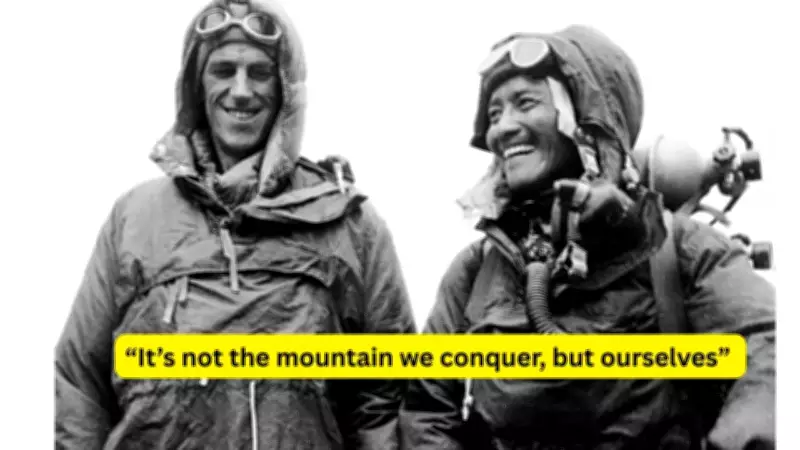
The Legacy of Sir Edmund Hillary: More Than a Mountain Climber
Sir Edmund Hillary, born on July 20, 1919, requires no formal introduction in the annals of exploration history. This New Zealand mountaineer, explorer, and philanthropist achieved what was once considered impossible when he became the first climber confirmed to have reached the summit of Mount Everest. Accompanied by Sherpa mountaineer Tenzing Norgay, Hillary conquered the world's highest peak on May 29, 1953, creating a moment that would forever change human understanding of physical and mental limits.
The Profound Wisdom Behind a Famous Quote
"It's not the mountain we conquer, but ourselves" stands as one of Hillary's most enduring statements, a philosophical gem that continues to resonate decades after its utterance. While initially appearing to reference the physical act of mountain climbing, this quote reveals deeper layers of meaning upon closer examination. The true essence speaks to the internal battles we all face—the mental challenges that often prove more formidable than any external obstacle.
This powerful statement addresses the fundamental nature of human struggle, growth, and achievement. It suggests that our greatest victories occur not when we overcome external barriers, but when we triumph over our own limitations, fears, and self-doubts. The quote encourages us to look inward, recognizing that the most significant conquests happen within our own minds and spirits.

The Mountain as Metaphor for Human Struggle
Mountain climbing represents one of humanity's most adventurous pursuits, with these towering natural formations long symbolizing obstacles, ambitions, and ultimate achievement. These immovable giants challenge daring individuals who wish to test their physical and psychological limits. Yet Hillary's words remind us that the external challenge—the mountain itself—is secondary to the internal battle we must wage.
Our fears, insecurities, and self-imposed limitations often create barriers more formidable than any geographical feature. We frequently constrain ourselves with endless "what if" scenarios rather than confronting challenges directly. To achieve anything truly meaningful and powerful, we must first overcome these internal obstacles, developing the courage to face uncertainty and the resilience to persevere through difficulty.
Travel and Adventure as Parallel Journeys
The philosophy behind Hillary's quote extends beautifully to travel and exploration. While we often romanticize travel as a series of beautiful experiences in exotic destinations, the reality involves confronting unfamiliar environments and navigating unexpected challenges. Those who embrace travel understand that the most profound transformations occur not merely in the places visited, but in how those experiences change the traveler from within.
Stepping into unfamiliar territory means leaving comfort zones behind, facing language barriers, cultural differences, and culinary adjustments. Travel presents unexpected setbacks that test patience, adaptability, and problem-solving skills. These moments—rather than the destinations themselves—define us as travelers and explorers. The journey becomes less about conquering a place and more about learning to navigate life at our own pace, taking one step at a time toward personal growth.
The Critical Role of Mindset in Achievement
Hillary's insight highlights the paramount importance of mindset in any endeavor. Consider two individuals climbing the same mountain: one might feel overwhelmed by the mountain's magnitude, while another discovers strength and a sense of achievement in the challenge. This contrast underscores a universal truth—success depends more on internal readiness and acceptance than on external circumstances.

True transformation occurs within us as we develop courage where fear once resided and confidence where doubt previously dominated. Travel provides a vivid illustration of this psychological evolution. Imagine someone planning their first solo trip: while the destination may be beautiful, the prospect of traveling alone can be intimidating. As the journey unfolds, however, the traveler learns to trust their instincts, make independent decisions, and face challenges with growing resilience. When the trip concludes, a new personal journey begins—one characterized by freedom, self-reliance, and empowerment.
The Enduring Relevance of Hillary's Wisdom
Ultimately, "It's not the mountain we conquer, but ourselves" serves as a timeless invitation to introspection. Hillary's words encourage us to examine our internal landscapes, recognizing that our greatest achievements come not from overcoming external obstacles alone, but from mastering our own fears, doubts, and limitations. Whether applied to mountaineering, travel, career challenges, or personal development, this philosophy reminds us that the most significant conquests are always internal victories.
As we reflect on Hillary's legacy—both his historic Everest ascent and his philosophical contributions—we find guidance for our own journeys. The mountains we face may vary in form and scale, but the essential challenge remains consistent: to conquer not what stands before us, but what holds us back from within.