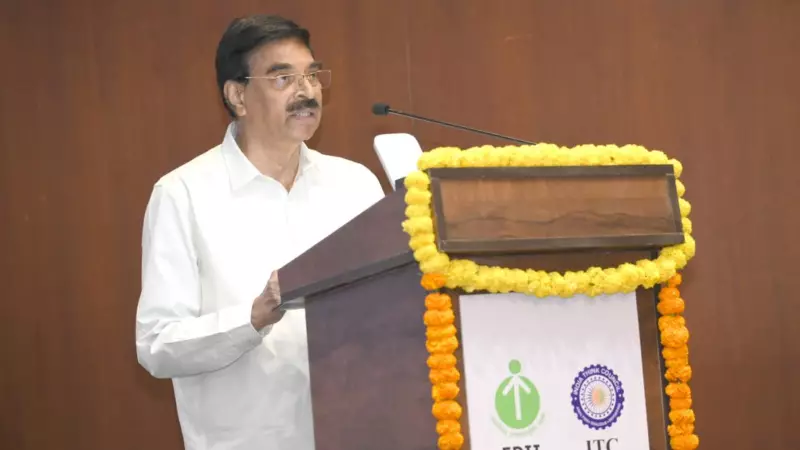
In a powerful address that linked India's rich heritage with its economic future, Odisha Governor Dr Hari Babu Kambhampati declared that preserving culture is not merely a source of pride but a fundamental national responsibility. He made these remarks while speaking at the culmination of 'Udyamita Pakhwada 2025 – 5th Cultural Economy Conclave' in Ahmedabad on Thursday, November 20, 2025.
The Inseparable Link Between Culture and Economy
Governor Kambhampati articulated a vision for a new India where cultural heritage and economic progress do not just coexist but actively strengthen and elevate one another. He pointed to the recent development of the Ram Temple in Ayodhya as a prime example of this powerful synergy. The Governor detailed how the temple has acted as a catalyst for comprehensive economic development in the region.
"Ayodhya is a very small town. It doesn't have any facilities. If a large number of people go, there is no place to stay," the Governor noted, describing the situation before the temple's completion. "But today, with the completion of the Ram temple, Ayodhya is having an International Airport, and many big groups are planning to build star hotels there." He emphasized that the temple has fundamentally changed the whole economy of Ayodhya, generating hundreds of jobs in sectors from transportation and taxi services to the sale of flowers and religious items.

Cultural Preservation as a Collective Duty
Reflecting on the nation's history, Dr Kambhampati stated that India's cultural heritage has demonstrated remarkable resilience, having withstood periods of invasion and neglect. However, he issued a sobering reminder that this legacy remains vulnerable. "Many priceless monuments, manuscripts, crafts and traditions have been lost forever," he observed.
This historical context, he argued, makes it the collective duty of citizens, institutions, governments, and communities to protect, preserve, and promote what remains of the nation's cultural wealth. For the Governor, this effort transcends nostalgia; it is a crucial act of national responsibility for the present and future.
Entrepreneurship and Cultural Phenomena
The conclave, a joint initiative of the Entrepreneurship Development Institute of India (EDII), Ahmedabad, and the India Think Council, also featured an address by Gujarat Minister for Forests and Environment, Climate Change, Science and Technology, Arjun Modhwadia. The Minister echoed the theme of interconnection, stating that entrepreneurship and start-ups are the need of the hour.
"Entrepreneurship finds a unique place in the culture and tradition of the country," Modhwadia said. "So, economic phenomena and cultural phenomena are interestingly interconnected."
Sunil Shukla, Director General of EDII, provided concrete data on the reach of the Entrepreneurship Fortnight (Udyamita Pakhwada). The event, organized across 10 states and 3 Union Territories, successfully reached out to over 3,000 individuals. This outreach included a significant focus on 1,500 women and 1,000 youth, with more than 100 local enterprises showcasing their products at exhibitions held during the fortnight.
The event ultimately served as a powerful platform to discuss how India's timeless cultural assets can be leveraged to build a dynamic and self-reliant economic future.