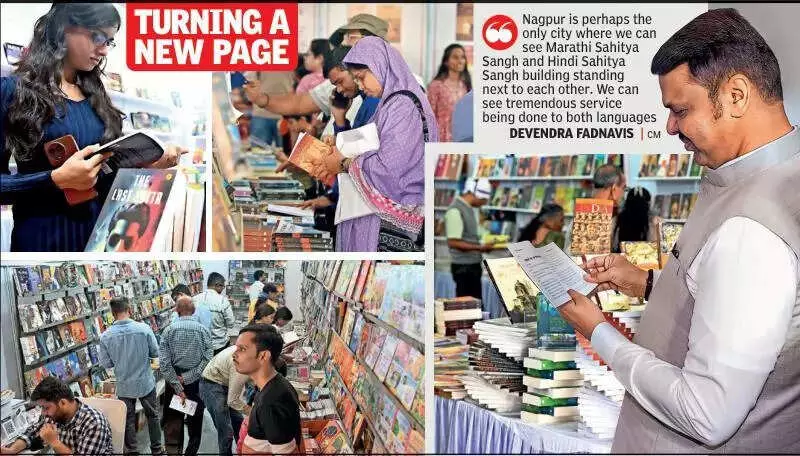
Maharashtra Chief Minister Devendra Fadnavis inaugurated the Zero Mile LitFest on Sunday, highlighting Nagpur's profound cultural and literary legacy during his address at the Nagpur Book Festival.
Nagpur's Historical Significance in National Movements
The Chief Minister emphasized how Nagpur has been instrumental in shaping India's destiny through various historical movements. "Nagpur city has witnessed many events that have given direction to this country," Fadnavis stated, specifically mentioning the rise of the Rashtriya Swayamsevak Sangh and the Dhammachakra Pravartan Din movement of Bharat Ratna Dr Babasaheb Ambedkar.
Fadnavis stressed the critical importance of understanding heritage for national progress. "Until we understand what our heritage is, until we realise who we are, India cannot reach the greatness of the past," he asserted, adding that "without understanding heritage, India cannot reclaim its Vishwaguru status."

Nagpur's Deep-Rooted Literary Culture
The CM traced Nagpur's literary origins back to the Gond rulers, revealing fascinating historical details about the city's educational foundations. "Gond King Bakht Buland created Nagpur city through Gondwana culture," Fadnavis explained. "Around 250 years ago, the Gond kings of Nagpur started public libraries in their palace, and a reading movement truly began in that era."
Fadnavis highlighted the unique literary confluence in Nagpur, noting that "it is perhaps the only city where we can see Marathi Sahitya Sangh and Hindi Sahitya Sangh building standing next to each other." He emphasized the tremendous service being done to both languages in the city.
Literary Contributions Across Eras
The Chief Minister showcased Nagpur's rich literary tradition spanning centuries:
- Ancient works like Harivijay and Viveksindhu by Mukundraj
- Modern writers including Shripad Krishna Kolhatkar, Raja Acharya Ram Shewalkar, Mahesh Elkunchwar, Suresh Bhat, and Parshuram Khude
- The Nagpurkar Bhosle's role in expanding Hindavi Swarajya after the city's establishment
From Internet to AI: The Evolution of Information
Fadnavis provided insightful commentary on the transformation of information consumption in modern times. "Actually, when this century began, we were in the internet era, now we have moved to the AI era," he observed.
The CM made a crucial distinction between information and knowledge in the digital age. "Through all these engines, we get shortcuts and quick information. Many times, instead of reading a complete book, we search the internet for the necessary information. If we give a prompt, we get all the needed information. It should be noted, though, that it is information and not knowledge," Fadnavis cautioned.
India's Educational Legacy and Colonial Impact
Fadnavis elaborated on India's historical knowledge systems, highlighting Takshashila University as a global educational hub. "Our culture created a university like Takshashila. Scholars from around the world used to come to Takshashila University for education," he stated.
The Chief Minister contrasted this with the colonial impact on India's education system, revealing startling statistics. "When the British came here, there were 2,000 grammar schools running in all of England, while 50,000 Sanskrit schools were running in the Madras Presidency alone," Fadnavis disclosed, adding that "our education system was killed, destroyed, and replaced with Macaulay's education system."
The Essence of Literature and Culture
Fadnavis concluded with profound reflections on what separates humanity from animality. "We all know what the real difference between humans and animals is — the difference is sensitivity. Because we have this medium of expression, we are cultured," he stated.
The CM emphasized that "where expression ends, culture ends. Where culture ends, the difference between humanity and animality completely ends."

Fadnavis congratulated the National Book Trust and praised the festival's role in nurturing reading culture and intellectual growth among Nagpur's youth, marking a significant step in reviving the city's rich literary traditions.