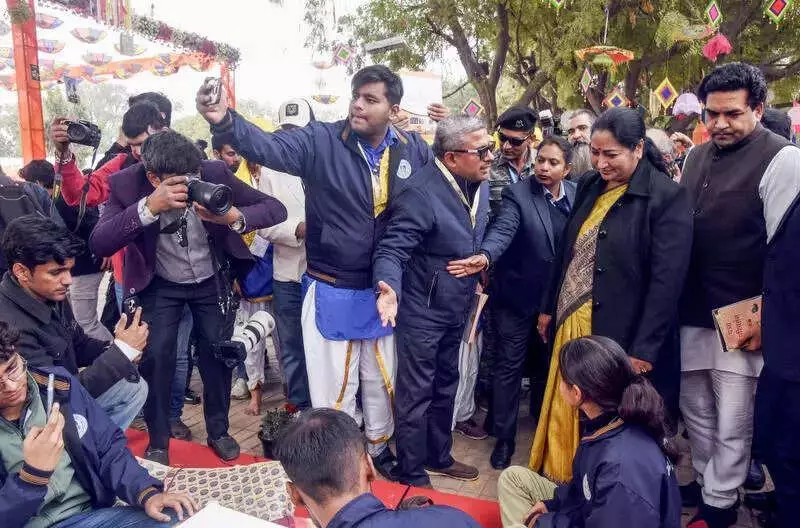
Chief Minister Rekha Gupta officially launched the Delhi Shabdotsav on Friday, setting the stage for a major cultural gathering in the national capital. During her inaugural address, she presented a powerful vision for India's progress, arguing that the nation must engage with its past, present, and future all at once to preserve its unique civilizational spirit.
A Festival for a Future-Oriented, Rooted India
Gupta described the Shabdotsav as a reflection of a forward-looking India that remains deeply connected to its cultural foundations. She acknowledged the historical challenges faced by the nation, noting that Indian civilization, culture, and education have endured repeated assaults but have always re-emerged stronger due to their profound roots. "Times change, but the soul of India is eternal," she stated, capturing the essence of her message.
The Chief Minister stressed that modernity in India must go hand-in-hand with traditional values. She identified a critical need for the current generation: to hold science in one hand and culture in the other. The festival's theme, Bharat Abhyudaya, was highlighted as a mirror to India's growing stature as an economic, political, strategic, and cultural power on the global stage.

Delhi as a Microcosm of 'Ek Bharat, Shreshtha Bharat'
Rekha Gupta also took the opportunity to spotlight the Delhi government's efforts to celebrate diverse regional festivals with equal authenticity. She listed celebrations like Chhath, Ganesh Chaturthi, Kanwar Yatra, Durga Puja, and Diwali as examples, calling Delhi a living embodiment of the 'Ek Bharat, Shreshtha Bharat' (One India, Great India) ideal. The Chief Minister announced that Shabdotsav would become an annual event, with plans for it to grow in scale and impact each successive year.
Union Minister of State Harsh Malhotra echoed the sentiment of cultural revival. He stated that Shabdotsav transcends books by showcasing India's ancient yet living heritage. Referencing historic centers of learning like Nalanda and Takshashila, Malhotra said India was a 'Vishwaguru' (world teacher) centuries ago and must reclaim that role by blending formal education with core values. "Degrees alone are not enough. Culture completes education," he asserted, adding that platforms like Shabdotsav are vital to connect the youth with India's rich traditions.
A 'Surgical Strike' on Ideological Extremism
Delhi's Culture and Tourism Minister, Kapil Mishra, delivered a pointed address with a sharper ideological focus. He began by stating that terrorism and violence are first born in the mind before manifesting as guns and bombs. "Naxalism, terrorism and ideological violence have their roots in thought. Delhi Shabdotsav is a surgical strike on that ideological terrorism," Mishra declared.
He criticized the past neglect of Delhi's cultural space, claiming it was previously diverted in "anti-cultural directions." Mishra credited Chief Minister Gupta's leadership for reversing this trend. By listing the grand celebrations of Chhath, Diwali at Kartavya Path, Kanwar Yatra, and Navratri, he underlined the government's aim to re-establish Delhi as the undisputed cultural capital of India.
The inaugural Delhi Shabdotsav is a large-scale event featuring:
- Over 100 speakers
- The release of more than 40 books
- Participation from 50 colleges
- Major poets' conferences
- Numerous cultural performances and open forums
The festival has already recorded an impressive nearly 60,000 registrations, indicating a strong public appetite for such a cultural confluence.