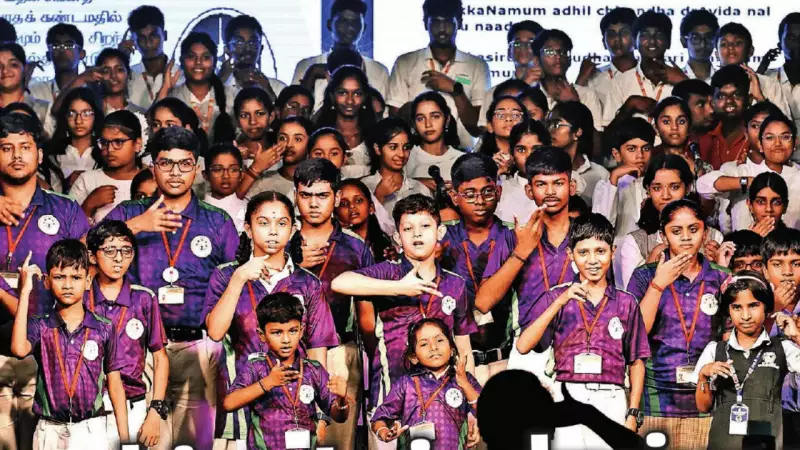
This Margazhi season in Chennai has witnessed a groundbreaking cultural event that is redefining the boundaries of classical music festivals. For the very first time in the city's history, a choir comprising more than 200 children—including able, disabled, and deaf participants—performed in unison with the entire audience as part of a pioneering inclusive sign-language choir.
A Vision for an Inclusive Margazhi
The monumental effort was orchestrated under Margazhi Matram, organized by Dr. Ranjini Kaushik. She views this initiative as a significant expansion of what the traditional Margazhi music season can encompass. "A sign-language choir singing is by far one of the most unique and inclusive ways of sharing the music season with people who are hearing impaired," Dr. Kaushik stated. The festival is pushing boundaries further by piloting sign-language interpretation and innovative Cymatic Carnatic tools, which help visualize sound. The ambitious goal is to pave the way for a future where "a multisensory Margazhi concert" becomes a standard norm, making classical music accessible to all.
Inside the Rehearsal: Rhythm, Gestures, and Dedication
The journey to the stage began with meticulous preparation focused on repetition, rhythm, and expressive gestures. Hephzibah Veronica, a special educator at Clarke School for the Deaf, explained the approach: "Exact words are difficult for them to grasp, so actions speak better." Students ranging from Class 1 to 12 diligently practiced three key pieces: the Tamil Thai Vaazhthu, the National Anthem, and Bharathiyar's iconic Manathil Uruthi Vendum.

For Hemant Kumar, a Class 9 student, lip-reading proved to be a valuable tool that made the learning process smoother, allowing him to embrace the performance with confidence. "It was simple. They taught me rhythmically and showed me how to sign even when there was no song," he shared. The educators noted the students' remarkable enthusiasm and obedience, which made the complex task achievable. The idea, which originated last year, naturally blossomed into a larger movement, as shared by the school's senior staff, Jayanthi Narayanan and Vijayalakshmi. They posed a poignant question: "Usually, only mainstream students do Margazhi kutcheris. Our children should also have the same experience, right?"
Beyond the Stage: Lasting Impact and a Cultural Shift
The immediate joy for the participating children was palpable and pure. Maanav, a Class 4 student, expressed his delight through sign: "I liked the training. I was very interested and enjoyed practising every day." However, the teachers and organizers hope the experience imparts lessons far greater than mere stage confidence. A special educator voiced a heartfelt sentiment, "I want my child to appreciate others… Their happiness is my happiness."
As the Margazhi festival continues to evolve, Dr. Ranjini Kaushik envisions this initiative sparking a profound cultural shift. "We need to make this into a movement," she asserts—a movement where sound, silence, and vision coexist seamlessly on stage, creating a truly inclusive artistic space for every member of the community.