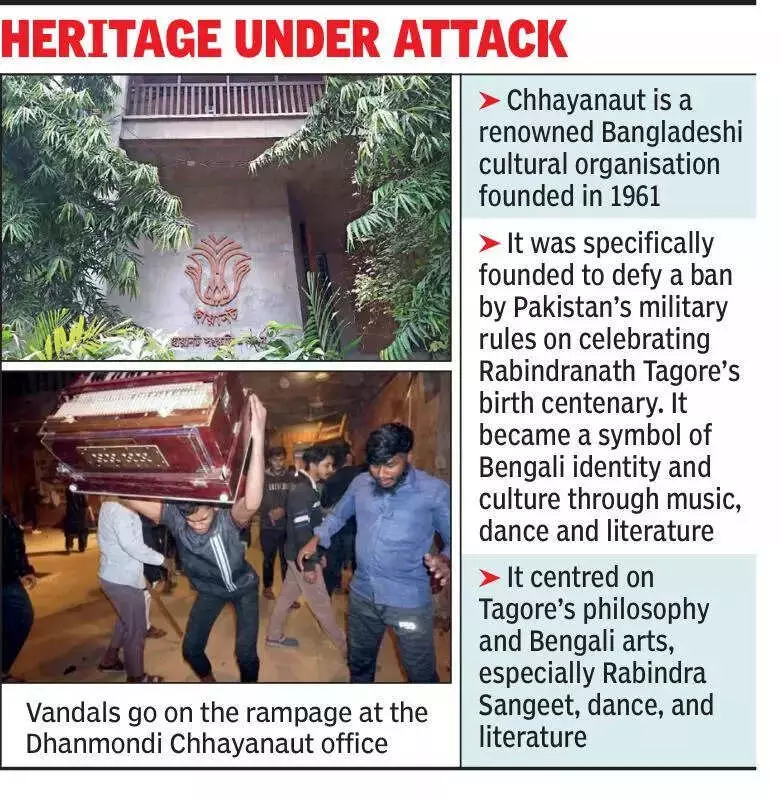
Prominent figures from West Bengal's cultural world have voiced strong condemnation following the shocking vandalism at the office of Chhayanaut in Dhaka's Dhanmondi area. The attack on one of Bangladesh's oldest and most revered cultural institutions has sent shockwaves through the artistic community across the border in India.
A Symbol of Bengali Identity Targeted
The incident occurred in the wake of the death of a political figure, Osman Hadi, a leader of the Inquilab Moncho. Chhayanaut, founded in 1961, holds a sacred place in Bengali history. It was established specifically to defy a ban imposed by Pakistan's military rulers on celebrating the birth centenary of Rabindranath Tagore. Over decades, it evolved into a powerful symbol of Bengali identity and culture, promoting music, dance, and literature.
Eminent poet Prabal Kumar Basu, chairperson of the Kolkata International Foundation for Arts, Literature and Culture, expressed deep anguish. Having visited Chhayanaut in 2012 with noted Bangladeshi intellectual Professor Anisuzzaman, Basu shared a personal connection with the institution's former president, the eminent musicologist Sanjida Khatun. "An attack on books of Tagore and Nazrul is an attack on civilisation itself," Basu stated, highlighting the profound symbolism of the destruction.

Artists from Kolkata Express Outrage and Pain
Renowned music director and composer Debojyoti Mishra described the attack as a harbinger of a dark age for Bangladesh. Having collaborated with Mita Haq, who led the Rabindra Sangeet department at Chhayanaut, Mishra emphasized the institution's role in preserving the authentic expression of Tagore's music. "It's time for Bangladesh's liberated, secular, creative, and erudite individuals to rise against fundamentalist forces," he urged.
The brutality has prompted concrete actions. Director Soumitra Dastidar has called off his planned visit to Dhaka for a seminar scheduled for December 22-24, stating he is "horrified by this brutality." He emphasized that Chhayanaut champions unity among Bengalis on both sides of the border and that institutions upholding secularism are being targeted.
For musicians like Pt Tanmoy Bose and Pt Tejendra Narayan Majumdar, the attack is a personal blow. Both hold cherished memories of performing at Chhayanaut. The sight of shattered rare instruments has hurt them profoundly. Bose condemned it as an attempt to "fracture the very backbone of our tradition," while Majumdar expressed deep pain upon learning of the loss from his students in Dhaka.
A Sadness Born from Anger
Veteran director Abhijit Dasgupta, who was in Dhaka during the 1971 Liberation War, summed up the sentiment with a mix of sorrow and fury. "It is sad. But this sadness is borne out of a deep sense of anger. An educated society will never do such a thing," he said. The collective response from Kolkata's cultural fraternity underscores a shared grief and a firm stand against forces threatening the secular, liberal fabric of Bengali culture, which transcends national boundaries.