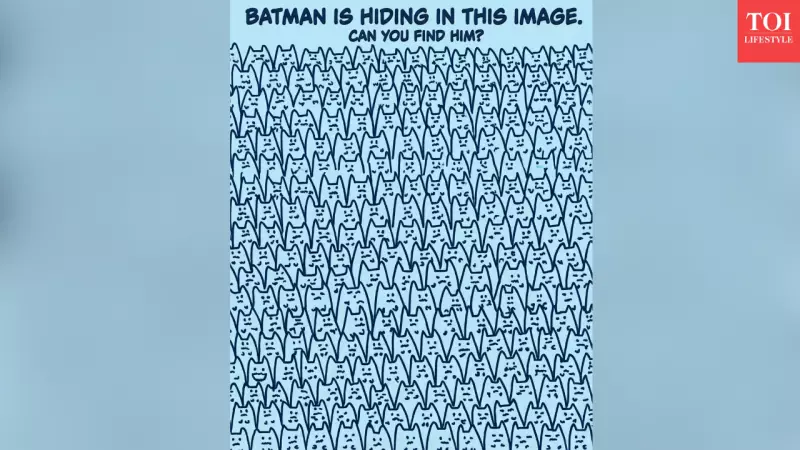
A new and captivating optical illusion is taking the internet by storm, challenging viewers to find the iconic superhero Batman cleverly concealed within a sea of nearly identical cartoon bats. This puzzle does more than just entertain; it offers a fascinating glimpse into how our eyes and brain work together, often relying on shortcuts that can make us miss crucial details.
The Science Behind the Batman Illusion
At first glance, the image presents a uniform crowd of bats. Their shapes, colors, and even facial expressions appear almost perfectly replicated. This deliberate repetition is the core of the illusion's trick. Our brains are wired to seek patterns and efficiency. When confronted with many similar objects, it quickly groups them into a single category, deciding "they are all the same" and stops processing each one individually. This cognitive shortcut is known as visual crowding.
Visual crowding explains why it's notoriously difficult to pick out a single friend in a packed stadium or locate a specific word on a cluttered page. In this Batman puzzle, the effect is used masterfully. Your brain perceives the image as a simple, repeating pattern, causing your eyes to glide over the one element that is different. The hidden Batman is not invisible; he is simply overlooked because our perceptual system filters him out.

How to Spot the Hidden Dark Knight
Finding Batman requires a conscious override of your brain's automatic processing. You must slow down and engage in a deliberate, systematic search. Most bats in the crowd have plain, simple faces. The key is to look for the one with slightly more defined features—a more prominent mask, a distinct nose, mouth, or eyes. The differences are subtle but present.
Experts suggest several strategies to beat the illusion. Instead of staring at the whole image, try scanning slowly row by row or column by column. Sometimes, changing your perspective helps; step back from the screen or zoom out to make the entire picture smaller. This can sometimes make the odd one out 'pop'. Other useful tricks include blinking, relaxing your gaze, or looking away briefly and then returning to reset your visual focus.
More Than Just a Game: A Lesson in Perception
This playful puzzle serves as a gentle reminder of a profound truth about human perception. Seeing is not the same as observing. What we notice is heavily influenced by context, our expectations, and the speed at which we process information. In daily life, this tendency can lead us to overlook important details when everything seems "close enough."
The Batman illusion rewards patience, attention to detail, and curiosity. If it took you a long time to find him, you're experiencing a completely normal function of your brain's efficient design. If you spotted him quickly, it indicates a keen eye for subtle discrepancies. Either way, the challenge highlights how truth can often sit right in front of us, hidden in plain sight, waiting for a truly attentive look.
Beyond the fun, such puzzles are engaging tools for understanding cognitive psychology. They illustrate the fascinating gap between the raw data our eyes receive and the interpreted reality our brain constructs, reminding us that our perception is an active, and sometimes flawed, construction.