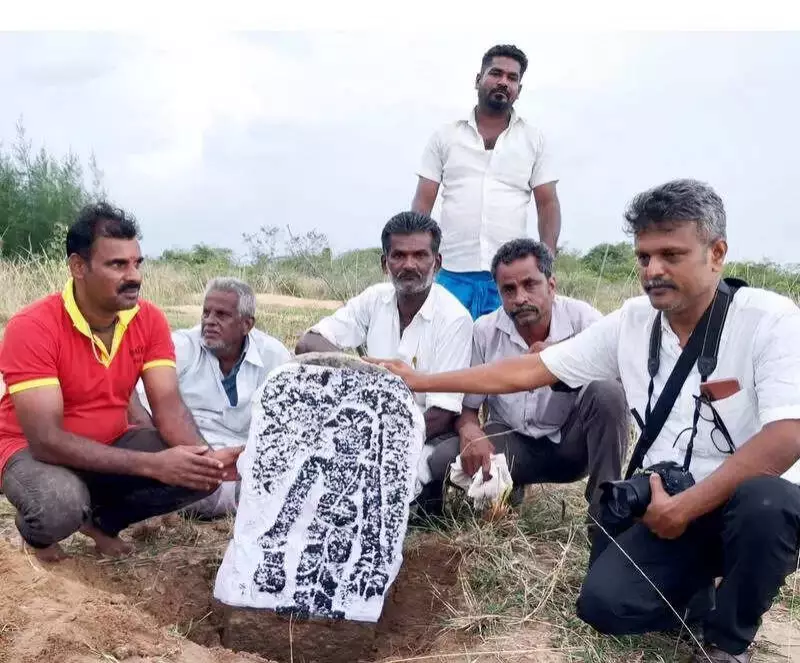
In a significant discovery for Tamil Nadu's historical record, a team of archaeological enthusiasts has unearthed a centuries-old stone inscription from the Tondaiman period in a remote village of Pudukkottai district. The find sheds new light on the region's tradition of philanthropy and public welfare systems.
A Discovery in the Fields of Senayakudi
The Tondaiman-era inscription was located on an agricultural plot known as Periya Vayalakkadu in Senayakudi village, which falls under the Kulathur taluk of Pudukkottai district. The team responsible for the discovery belongs to the Pudukkottai Archaeological Research Forum. Its founder, Manikandan, provided detailed insights into the artifact's importance.
The stone slab is notable for its carved imagery. One side features a bas-relief of 'Vamana', an avatar of Lord Vishnu. This specific motif was not merely decorative; it served a formal purpose. In historical context, the image of Vamana was traditionally used to signify and sanctify land grants made for charitable and religious purposes, marking the transaction as both legal and sacred.

Deciphering the Historical Grant
The other side of the slab contains the inscription that details the actual grant. According to Manikandan, the text records that valayan kulam (a pond) and the surrounding agricultural fields were donated. The beneficiary of this generous grant was the Thirumalai Raya Puram Anna Chathiram.
This chathiram was a rest house that provided essential services to travellers and pilgrims navigating the region. The income generated from the donated pond and fields was specifically earmarked to cover the food and maintenance expenses of the facility, ensuring its sustainable operation.
The Legacy of the Tondaiman Chathirams
Manikandan elaborated on the historical context, revealing that the area known today as Chinnaiya Chathiram was originally called Thirumalai Raya Puram. The rest house itself has a precise founding date: it was established in 1788.
The founder was Thirumalai Tondaiman, a jagirdar (landholder) of the Chinna Aranmanai and a relative of the reigning Tondaiman king. Over the decades, the name evolved colloquially from 'Thirumalai Raya Puram Anna Chathiram' to 'Chinna Ayya Chathiram', which eventually became the present-day Chinnaiya Chathiram.
This was not an isolated act of charity. The Tondaiman rulers were known for building an extensive network of such chathirams across their territory. Other examples include those at:
- Ayipatti (founded 1779)
- Onangudi (founded 1783)
- Vadavalam west
These institutions formed a crucial social infrastructure, offering free food, water, and shelter to weary travellers, thereby facilitating trade, pilgrimage, and connectivity.
Concluding his remarks, Manikandan issued a call for greater conservation efforts to protect these invaluable historic structures. He described them not just as old buildings, but as enduring symbols of public welfare and generosity from a bygone era, whose legacy deserves to be preserved for future generations.