Ancient DNA Study Uncovers Male-Dominated Social System in Neolithic Scotland
A revolutionary genetic analysis of ancient human remains has provided unprecedented insights into the social organization of Stone Age Britain. Researchers have examined DNA extracted from 40 individuals buried in stalled cairns across Caithness and Orkney, revealing evidence of a highly structured, male-dominated social system that persisted for over five centuries.
Web of Descent: Tracing Male Lineages Through Generations
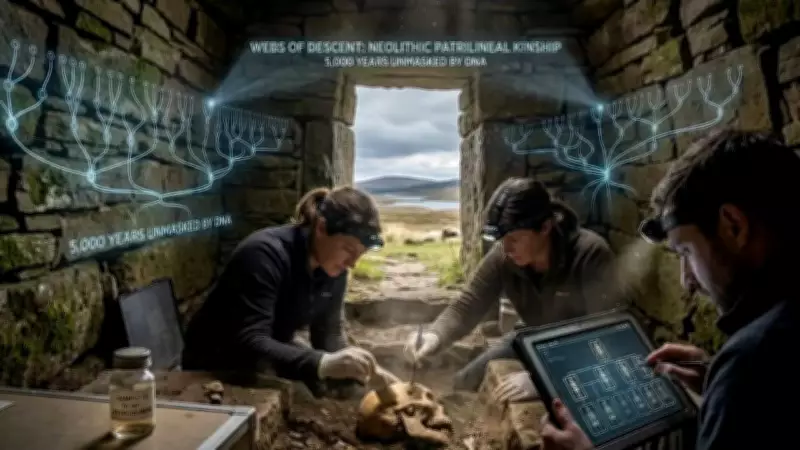
The study uncovered what scientists describe as a 'web of descent' where men from at least seven generations of male relatives were buried in close proximity to one another. The reconstructed family tree indicates that men consistently remained in their natal communities throughout their lives, while women migrated between residences to establish new kinship relationships.
This research significantly advances our understanding of biological and social hierarchies during Neolithic Britain. The monumental tombs constructed during this era served as sacred, genealogical connections between specific male families, functioning as more than mere community burial sites.

DNA Breakthrough: Mapping 5,000-Year-Old Genetic Connections
The discovery stems from high-resolution genetic mapping of individuals who lived at sites including Tulloch of Assery B and Holm of Papa Westray North. Researchers identified nine pairs of genetically close relatives, all connected exclusively through male ancestors. This finding demonstrates that these stalled cairns served as exclusive burial vaults for specific male lineages rather than general community burial pits.
Women's Role in Forming Neolithic Social Networks
The research published in Nature Communications reveals that Neolithic Scotland operated under a patrilocal system where men remained with their birth families while women typically relocated to their marital communities. This pattern is evident in the greater diversity of mitochondrial (maternal) DNA compared to the restricted nature of Y-chromosome (paternal) lineages found within the tombs.
The biological evidence strongly suggests that women's movement between communities was a primary driver for forming inter-community networks during the 4th millennium BC. This migration pattern created vital social connections across different settlements while maintaining distinct male lineages within specific geographic areas.
Architectural Mirror of Social Structure
Archaeologists from the University of the Highlands and Islands and the University of Exeter propose that the architectural design of these tombs directly reflects the compartmentalized nature of the social lineages they contained. The stalls or compartments within the tombs physically represented the segmented social structures stemming from male ancestors buried within them.
These monumental structures served as tangible representations of social lineages, providing physical presence for deceased ancestors that legitimized living descendants' claims to land rights and social status. The tombs essentially functioned as genealogical monuments that reinforced social hierarchies across generations.
Advanced DNA Techniques Revive Ancient Genomes
Researchers employed cutting-edge approaches to date and analyze human remains, utilizing skulls collected from Scottish tombs that were specially sampled to extract high-quality ancient DNA. The team achieved usable genomic sequences through a technique called 'petrous bone extraction,' focusing on a dense bone in the inner ear particularly suitable for sequential analysis.
This method proved effective even with remains preserved in Scotland's acidic soils, ultimately revealing multi-generational lineages spanning 250 to 300 years at individual tomb sites. The technological advancements in ancient DNA analysis have opened new windows into understanding social organization patterns that persisted for centuries during the Neolithic period.