In a landmark discovery that rewrites chapters of ancient history, archaeologists have unearthed significant portions of a 4,500-year-old sun temple complex in northern Egypt. This monumental find is directly associated with King Nyuserre, a powerful ruler of the Fifth Dynasty, who was profoundly connected to the worship of the sun god Ra.
Unearthing a Lost Monument in Abusir
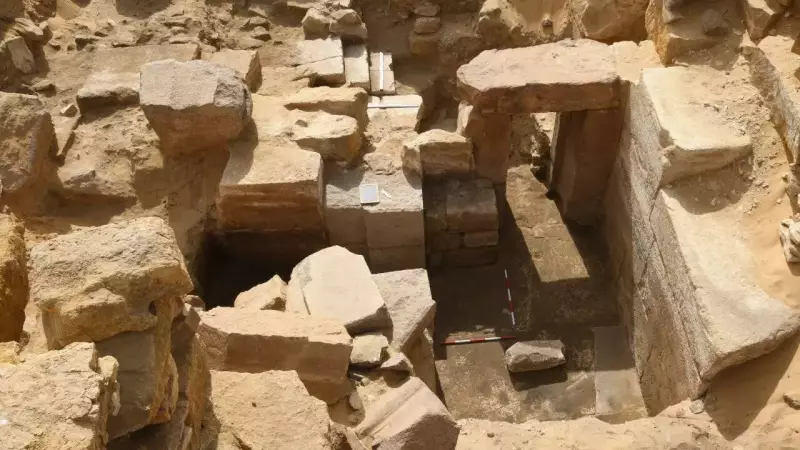
The groundbreaking work was carried out by an Italian archaeological mission in the Abu Ghurab area, located within the famed Abusir necropolis near Memphis. This zone is already renowned for its concentration of royal monuments from the Fifth Dynasty. The team successfully revealed more than half of the Valley Temple belonging to Nyuserre's solar complex, exposing a structure covering an impressive area of over 1,000 square metres.
Experts describe the edifice as not only vast in scale but also meticulously planned. Its architectural blueprint distinguishes it from the typical valley temples connected to pyramids. A key factor in its preservation was the thick layers of Nile silt that had sealed the temple entrance, protecting the original limestone flooring, column bases, and granite elements in their pristine state. This discovery finally validates the early 20th-century observations of German Egyptologist Ludwig Borchardt, who had identified the site in 1901 but could not excavate due to a high water table.

A Temple at the Heart of Religious Reform
This discovery provides crucial physical evidence for a pivotal shift in ancient Egyptian state ideology. According to Egypt's Ministry of Tourism and Antiquities, the temple's design and function are intrinsically linked to the Fifth Dynasty religious reforms, a period when the worship of Ra ascended to dominate the official state religion.
Evidence from the site powerfully supports this. An enormous stone lintel, inscribed with depictions of King Nyuserre and details of a ritual calendar, confirms the temple's active role in the state-sponsored solar cult. Architectural features like a procession hallway, granite lintels, and an additional staircase suggest the space was designed for orchestrated ceremonial movement, indicating it was a venue for dynamic ritual performance, not merely a symbolic monument.
Artefacts Tell a Tale of Ritual and Daily Life
Beyond the architecture, a rich collection of artefacts offers a vivid glimpse into the temple's history. Fragments of fine white limestone bearing hieroglyphs, likely from wall decorations, were scattered across the precinct. The pottery found spans from the end of the Old Kingdom into the Middle Kingdom, with a strong representation from the politically turbulent First Intermediate Period.
Among the most intriguing finds are two wooden Senet game boards. In ancient Egypt, Senet was not just a pastime but a game imbued with religious symbolism. Their presence hints that the temple complex was also a living space for priests or attendants who may have resided there for extended periods.
This theory of adaptation is strengthened by evidence that the temple was repurposed after its original use declined. During the First Intermediate Period, sections appear to have been converted into a small residential neighbourhood for local clerks and inhabitants. Signs of this recycling include domestic pottery, altered floor levels, and traces of everyday activities atop the once-sacred ceremonial surfaces.
Ongoing excavations aim to uncover more about the temple's connection to the Nile via a sloping access route and its links to other Fifth Dynasty monuments in Abusir. This work promises to deliver a more precise understanding of how sun temples evolved within Egypt's sacred landscape, bridging the gap between divine kingship and the daily lives of its people.