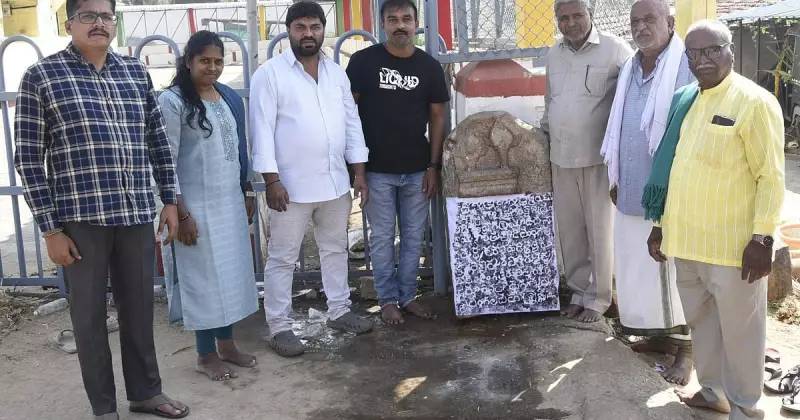
A significant archaeological discovery in Karnataka's Mandya district is rewriting our understanding of 12th-century South Indian history. A detailed inscription, found on a broken soapstone slab, has provided compelling evidence of a close and active relationship between the Hoysala kingdom of Karnataka and the Tamilakam region.
Discovery at Sri Mahalakshmi Temple
The key to this historical revelation was found at the Sri Mahalakshmi Temple located in K Bettahalli, Pandavapura taluk, Mandya district. The inscription is carved onto a damaged soapstone 'Kalasha', a type of architectural element. This artifact serves as a direct window into the socio-political and cultural dynamics of the 12th century, a period marked by the expansion and consolidation of Hoysala power under rulers like Vishnuvardhana.
Deciphering the Historical Connection
While the full textual content of the inscription is detailed in the original research, its primary significance lies in its testimony to the "close relation between Hoysala Karnataka and Tamilakam". This term, Tamilakam, refers to the geographical and cultural realm of the Tamil people, which during that era included parts of modern-day Tamil Nadu and Kerala. The finding challenges any notion of isolated kingdoms and instead points to a landscape of interaction, which likely included:

- Political alliances and diplomatic exchanges.
- Movement of artisans, scholars, and religious figures.
- Shared artistic and architectural influences, evident in later Hoysala temple architecture.
- Economic and trade links across the Deccan plateau.
Implications for South Indian History
This discovery in Mandya adds substantial weight to the growing body of evidence that medieval South Indian kingdoms were deeply interconnected. The Hoysalas, often celebrated for their distinct Kannada heritage and spectacular temple art in places like Belur and Halebidu, were also active participants in a broader pan-South Indian cultural milieu. The inscription confirms that their influence and engagements extended significantly into the Tamil region.
The research, highlighted by experts Sneha Madiyalkar and Md Hussain, and reported on 07 January 2026, underscores the importance of local temple archaeology. Often, such regional sites hold untapped archives that can alter historical narratives. This 12th-century inscription is more than just a damaged stone; it is a documented proof of centuries-old bonds that shaped the civilization of southern India, reminding us that history is often written in the connections between cultures, not just their conflicts.