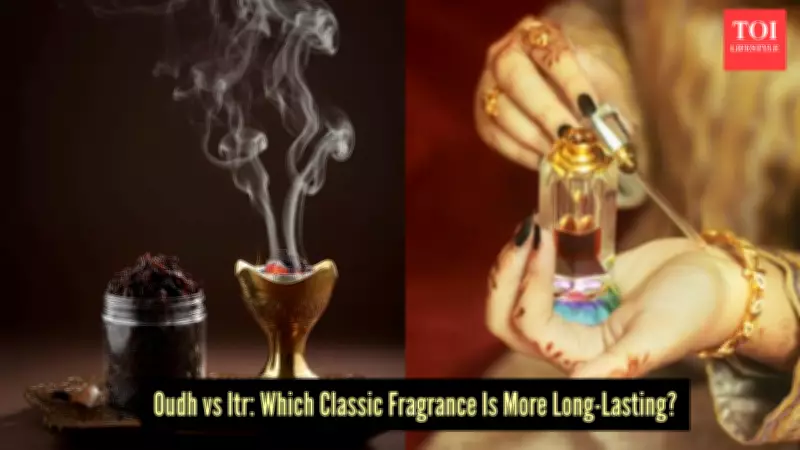
Oudh vs Itr: The Ultimate Showdown for Longest-Lasting Fragrance
You apply your favorite designer perfume in the morning, head out into the busy urban environment, and by midday, the aroma has completely disappeared. Does this scenario sound familiar? It is an extremely widespread issue that many fragrance enthusiasts face regularly.
This precise annoyance has driven contemporary perfume lovers directly back to the ancient origins of scent creation. Currently, traditional, alcohol-free oils are experiencing a significant resurgence and taking over the fragrance industry. However, in the decisive contest for staying power, two major contenders frequently compete: Oudh and Itr. Both are opulent. Both are steeped in tradition. So, which one truly merits the title for endurance? We have unraveled the chemistry and centuries-old mysteries behind these iconic oils to assist you in selecting your ultimate signature scent.
Laying the Groundwork: What Are We Actually Comparing?
Before we can award the trophy for the most long-lasting fragrance, we must first outline the fundamental distinctions between the two competitors. People often use these two terms interchangeably in everyday discussion. Nevertheless, they are essentially different.

Consider Itr, commonly referred to as Attar, as a broad, overarching category. It simply denotes traditional perfume oils manufactured entirely without alcohol. To produce a classic Itr, fragrant botanical components—such as fresh roses, delicate jasmine petals, or earthy vetiver—are meticulously distilled. The essence is then captured in a heavy botanical base. Historically, this base is almost always pure sandalwood oil.
Oudh, conversely, is a very specific, highly valued single ingredient. Also known as Agarwood, it is a dark, intensely fragrant resin. Its formation is utterly fascinating. The Aquilaria tree generates this rich resin naturally, but only when it becomes infected by a particular type of mold. You can wear pure Oudh oil, traditionally called Dehn al Oudh, by itself as a standalone fragrance, or perfumers can blend it into an Itr to craft a more intricate scent profile.
The Ultimate Longevity Test: Skin and Fabric
Because both of these alternatives are pure oils completely free from fast-evaporating alcohol, they naturally adhere more closely to your skin. This immediately enables both to outlast those standard commercial spray perfumes available at shopping malls. However, the real challenge occurs when you directly compare a standard floral or herbal Itr with pure Oudh oil.
When you conduct that comparison, Oudh almost invariably emerges victorious. A high-quality, standard floral Itr will certainly provide a robust performance. You can generally anticipate it lasting anywhere from 6 to 12 hours directly on your skin. That is sufficient to carry you through an entire workday.
But pure, aged Oudh oil functions on a wholly different level of durability. A few minuscule drops can easily persist for 12 to 24 hours on the skin. And if that oil accidentally contacts your clothing? Be cautious. The rich aroma can remain on fabric for days, or occasionally even weeks, tenaciously enduring multiple cycles in the washing machine.
The Science Behind the Scent
Why is there such a substantial disparity in how long they endure? It all comes down to molecular weight. In the captivating realm of perfumery, how long a scent survives is strictly governed by how rapidly its molecules evaporate into the air.
Oudh is an exceptionally dense, heavy resin. In fragrance composition, resins and woods naturally serve as base notes. These base notes possess the absolutely largest molecules, which naturally corresponds to the slowest evaporation rates.
Standard Itrs, meanwhile, typically depend heavily on much lighter floral molecules like Gulab (Rose), Chameli (Jasmine), or Kewra. Even with that rich sandalwood base attempting to anchor the delightful scent to your skin, those delicate floral notes simply evaporate much faster than heavy, dense wood.
The Final Verdict
The winner is evident. If sheer, unparalleled longevity is your ultimate priority when purchasing a fragrance, pure Oudh is the undisputed champion. Alternatively, an Itr that is heavily based on Oudh and musk will also yield remarkable results.

The dense, complex, and profoundly woody profile of the agarwood resin simply requires considerably more time to break down and fade away compared to the lighter botanicals found in traditional floral or earthy Itrs. The next time you desire a signature scent that will vigorously outlast your most extended days, you know exactly which bottle to select.