

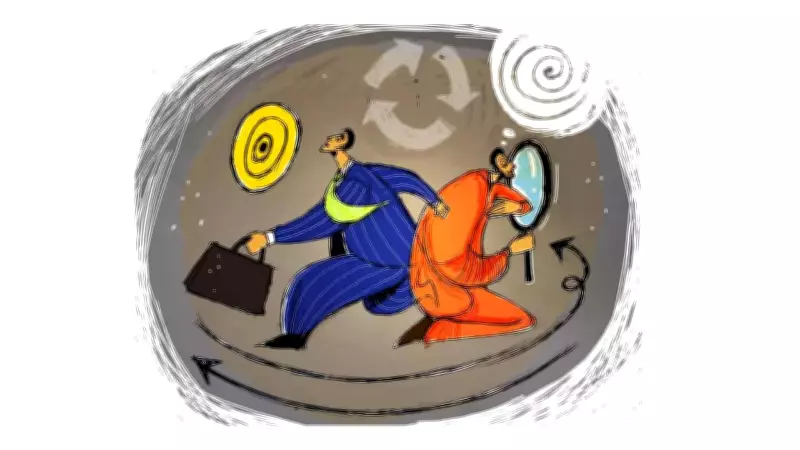
The Modern Dilemma: Constant Doing Versus Mindful Being
Contemporary society celebrates movement, speed, and relentless output above all else. We idolize the perpetually busy, applaud the hyper-productive, and subtly equate non-stop activity with genuine purpose and fulfillment. In this cultural climate, silence often feels uncomfortable, rest triggers guilt, and stillness is frequently dismissed as unproductive or lazy. This pervasive mindset ensures that doing dominates our daily existence, while the essential state of being gets relegated to the background. However, human life truly unfolds with meaning and depth only when these two fundamental modes—action and awareness—maintain a delicate and conscious balance.
Karm Yog: The Path of Selfless Action
The Bhagavad Gita provides profound and refined reflections on the relationship between action and inner peace. Lord Krishna explains that both Karm Yog, the path of selfless action, and Sanyas, the path of renunciation, ultimately lead to the same spiritual goal. Krishna emphasizes that Karm Yog is a particularly suitable and accessible path for most people engaged in worldly life. True renunciation, according to this wisdom, is not a physical withdrawal from life's responsibilities. Rather, it is the inner freedom from craving, attachment, and the ego's compulsive need to control outcomes. Action performed without obsession over results gradually purifies the mind. When doing is guided by this heightened awareness, it transforms into a direct doorway to being. Krishna further clarifies that authentic renunciation involves seeing the Divine in all beings, a state cultivated through consistent, selfless action performed with a detached mind.
The Four Ashrams: Life's Progressive Journey
Traditional Indian thought conceptualizes human life as a stepwise progression designed to facilitate a gradual inner shift. The four ashrams—Brahmacharya (student life), Grihastha (householder life), Vanaprastha (retired life), and Sanyas (renunciate life)—beautifully map this spiritual journey. Early and middle life are naturally oriented toward learning, duty, responsibility, and active contribution to society. The later stages of life are intentionally meant for deeper reflection, contemplation, and the cultivation of inner peace. This framework acknowledges that a life solely focused on action is incomplete; it must evolve to include periods dedicated to introspection and being.

The Three Gunas: Understanding Our Inner Drives
Indian philosophy offers a nuanced lens to understand human behavior and consciousness through the concept of the three gunas, or fundamental qualities. Tamas represents inertia, dullness, and lethargy. Rajas embodies activity, ambition, passion, and a restless drive to possess and achieve. Sattva signifies clarity, balance, purity, and harmony. Youth and adulthood are naturally dominated by rajasic energy—the powerful drive to assert oneself, build a career, and accomplish goals. The problem arises when rajas becomes a permanent, unchecked state, leading to burnout and inner turmoil. With maturity and conscious effort, life should gently transition towards sattva, where actions are guided by clarity and wisdom rather than compulsion and agitation. One continues to act in the world, but with significantly less inner noise and conflict.
Ashtang Yog: The Systematic Path to Integration
The yogic path meticulously outlined by Rishi Patanjali in the Yoga Sutras describes this movement from outer action to inner awareness with precision. The Ashtang Yog, or Eight-Limbed Yoga, system begins with ethical disciplines and bodily regulations (Yamas and Niyamas), progresses through Asana (posture) and Pranayama (breath control), then directs awareness inward through Pratyahara (sense withdrawal), and finally culminates in Dharana (concentration), Dhyana (meditation), and Samadhi (absorption or enlightenment). Significantly, the very first principle of the Yamas is Ahimsa, or non-violence. Much of modern "doing" carries subtle forms of violence—towards ourselves through stress and towards others through competition and comparison.

From Inner Unrest to Peaceful Response
The French philosopher Blaise Pascal once astutely observed, "All of humanity's problems stem from man's inability to sit quietly in a room alone." Driven by a deep-seated dissatisfaction with the present moment, our actions often spring from the nagging feeling that 'this is not enough' or 'I am not enough.' From this fundamental unease emerge comparison, fear, anxiety, and constant, often unnecessary, interference. Even actions with good intentions can cause harm when they originate from this place of inner unrest and agitation.
Conversely, the state of Being is frequently misunderstood as mere passivity or inactivity. In reality, being is characterized by conscious presence without aggression. It means accepting what is, without resignation or helplessness, and acting when necessary without inner disturbance or reactivity. When an individual is grounded in being, actions arise naturally, appropriately, and proportionately. There is a diminished urge to frantically control outcomes or forcefully engineer change. Life, consequently, no longer feels like a perpetual battlefield. One learns to peacefully and wisely 'respond' to situations rather than aggressively and impulsively 'react' to them.
The Wisdom of Balance and Simplicity
The delicate equilibrium between proactive action and graceful acceptance is beautifully encapsulated in the widely known Serenity Prayer, as explained by theologian Reinhold Niebuhr: "Dear God, please grant me the courage to change what can be changed, the serenity to accept what cannot be changed, and the wisdom to know the difference."
Embracing a life of conscious simplicity plays a crucial role in facilitating this inner transition. Simplicity liberates us from unnecessary complexity, social comparison, and the pressure of display. It reduces external noise and clutter, thereby creating vital mental and emotional space for self-awareness and reflection. When our outer life is less frenetic and cluttered, our inner life naturally has the room to settle, blossom, and find its own rhythm.
Ultimately, a fulfilling life is not a battleground between doing and being. It is a harmonious and dynamic dance between the two. Genuine peace does not arise from withdrawing from life's responsibilities, but from cultivating the wisdom to know when to act with full engagement and when to simply be with full awareness. It is a state where all doing happens infused with the clarity and tranquility of being.
Authored by: Dr. Bharat Rawat (The writer is a practicing cardiologist)





