Vertebrate Vision Traced to 600-Million-Year-Old Marine Ancestor
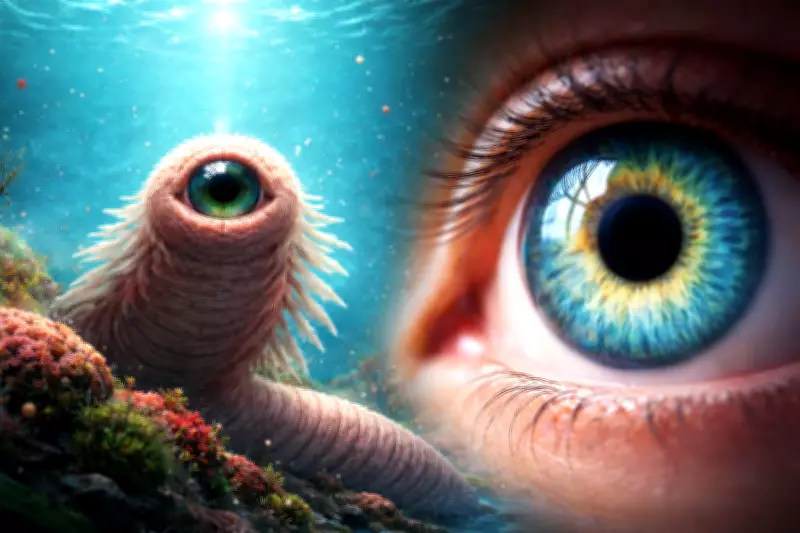
Groundbreaking research from Lund University and the University of Sussex has uncovered the ancient origins of the vertebrate eye, tracing it back to a small marine creature that inhabited Earth's oceans nearly 600 million years ago. The study, published in the prestigious journal Current Biology, presents compelling evidence that all vertebrates evolved from an ancestor possessing a single light-sensing organ positioned on the top of its head.
The Ancient Median Eye: Foundation of Modern Vision
The distant ancestor described in the research paper "Evolution of the vertebrate retina by repurposing of a composite ancestral median eye" was a soft-bodied marine organism that lived a relatively sedentary existence, filtering plankton from ancient seas. This creature's evolutionary lineage likely included ancestors with paired eyes, though researchers remain uncertain whether these structures formed clear images or simply detected basic light patterns.
At some critical juncture in evolutionary history, these paired structures disappeared as the organism's quieter lifestyle made them less essential for survival. What remained was a crucial cluster of light-sensitive cells positioned along the midline of the head, which gradually developed into a simple median eye capable of distinguishing light from darkness and potentially detecting orientation, though not designed for detailed visual perception.

From Single Organ to Paired Eyes: An Evolutionary Detour
Later evolutionary shifts brought significant changes as descendants of this ancient creature returned to more active movement patterns. The demands of swimming and navigating aquatic environments required enhanced spatial awareness, prompting remarkable adaptations within the median eye structure.
According to the research team, portions of this median eye were repurposed and adapted over millions of years, eventually giving rise to the sophisticated paired eyes that characterize modern vertebrates. This evolutionary pathway represents a significant departure from what scientists observe in insects or squid, where eyes typically develop from skin cells at the sides of the head rather than from brain tissue as in vertebrates.
Professor Dan E Nilsson, emeritus professor in sensory biology at Lund University, described these findings as particularly unexpected, noting that vertebrate eyes did not evolve in parallel with other complex visual systems but followed a unique detour shaped by changing behavioral patterns and environmental pressures.
The Pineal Gland: Living Remnant of Ancient Vision
The median eye did not vanish completely from the evolutionary record. Researchers propose that its remnants persist in modern vertebrates as the pineal gland, a small but crucial structure located near the center of the brain that maintains light sensitivity through indirect pathways.
This gland produces melatonin, the hormone responsible for regulating circadian rhythms and sleep-wake cycles. The research team argues that this fundamental biological function can be directly traced back to the ancient light-sensing cells of the median eye, creating a remarkable evolutionary connection between modern sleep regulation and primitive visual systems.
While the idea that contemporary sleep patterns connect to a cyclops-like ancestor might seem far-fetched, cellular evidence drawn from comprehensive comparisons across diverse animal groups consistently points in this direction. The evolutionary journey appears considerably more indirect than previously assumed, shaped by periods of loss, adaptation, and remarkable resurgence over hundreds of millions of years.
Revisiting Evolutionary Assumptions
This research fundamentally challenges long-held assumptions about how complex vision evolved in vertebrates. Rather than following a straightforward progression from simple to complex structures, the evidence suggests a more circuitous path influenced by changing lifestyles and environmental conditions.

The study centers on understanding how light-sensitive cells, their positioning within the body, and repeated lifestyle transitions may have altered their functions across geological time scales. This new perspective provides fresh insights into the remarkable adaptability of biological systems and the unexpected ways in which evolution repurposes existing structures for new functions.
By examining the evolutionary history of vertebrate vision through this novel lens, researchers have opened new avenues for understanding how complex sensory systems develop and adapt over deep time, offering valuable perspectives on both our biological heritage and the fundamental processes that shape life on Earth.