A revealing community-based study from Visakhapatnam has provided critical insights into the silent, long-standing circulation of dengue and chikungunya viruses in the region. Conducted by researchers from the Department of Community Medicine at Andhra Medical College, the research focused on five partly urbanised and peri-urban clusters near Simhachalam.
Key Findings: A Paradox of High Immunity and Low Case Detection
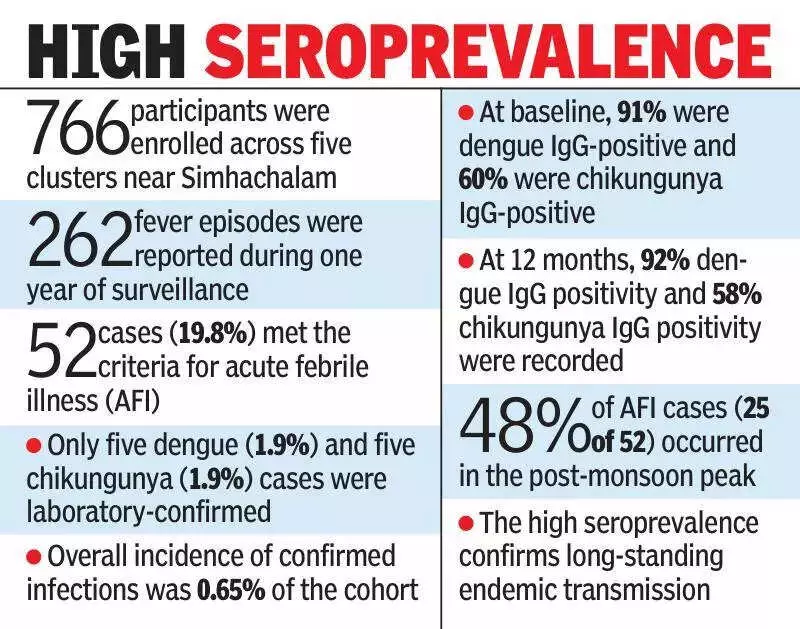
Over a rigorous one-year surveillance period, the study enrolled 766 participants and tracked 262 reported fever episodes. From these, 52 cases (19.8%) met the criteria for acute febrile illness (AFI). However, laboratory confirmation revealed a surprisingly low number of active infections: only five dengue cases (1.9%) and five chikungunya cases (1.9%). This translated to a minimal incidence rate of just 0.65% across the entire cohort.
In stark contrast, serological analysis painted a different picture of widespread past exposure. At the study's start, a staggering 91% of participants tested positive for dengue IgG antibodies, indicating prior infection. For chikungunya, this figure stood at 60%. These high seroprevalence levels remained remarkably stable after 12 months, at 92% and 58% respectively.

Seasonal Patterns and Endemic Transmission Confirmed
The research identified a clear seasonal spike in fever cases. Nearly half of all AFI cases (48%, or 25 out of 52) occurred specifically during September and October of 2023. This period aligns with the post-monsoon season, which is notorious for peak mosquito breeding activity.
Together, these findings underscore a critical public health reality: Visakhapatnam experiences persistent endemic transmission of both diseases. The high background immunity in the population likely results in most infections being asymptomatic or mild, thereby masking the true burden of the viruses. The study's authors, including Dr. PJ Srinivas, Dr. KK Lakshmi Prasad, and Dr. Surada Chandrika, emphasized this point.
"Although the number of active infections was small, the widespread presence of IgG antibodies across age groups are consistent with long-standing endemic transmission and substantial population-level immunity," the researchers told TOI.
Broader Implications and Study Methodology
This trend in Visakhapatnam mirrors broader national data, where dengue seroprevalence in India ranges between 49-60% and chikungunya between 18-25%, with significant regional variations. The Vizag clusters thus act as a microcosm, showing how endemic transmission is sustained by a combination of local climate, mosquito ecology, and built-up population immunity.
Funded by the Biotechnology Industry Research Assistance Council (BIRAC) and published in the 'Archives of Clinical and Biomedical Research' journal, the study's strength lies in its community-based design and longitudinal serological tracking. The researchers acknowledge limitations, such as the sample size and reliance on self-reported fever, but stress that serological surveys are an indispensable tool for uncovering hidden transmission dynamics that routine case reporting misses.
This research highlights the importance of serosurveys in shaping accurate public health strategies for vector-borne diseases in urbanising India, moving beyond just counting symptomatic cases to understanding the full landscape of infection and immunity.