

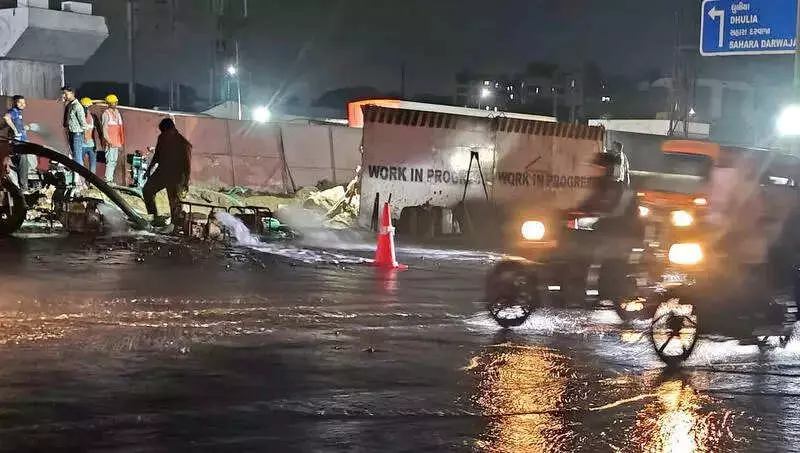
A recent major pipeline failure in Surat has starkly exposed the vulnerabilities within the water distribution system of India's eighth-largest city. The incident, which took a full 24 hours to repair, has amplified serious concerns among civic authorities about the potential for rapid, widespread contamination due to the deeply interconnected nature of the pipeline network.
The 24-Hour Repair That Revealed a Systemic Flaw
When a key water supply pipeline in Surat was damaged, municipal authorities initially planned a localized repair affecting only one area. However, the plan quickly unraveled. The interconnected web of pipelines meant water kept flowing to the damaged site from multiple directions, flooding the area and severely hampering repair work. Consequently, what was meant to be a controlled operation forced the Surat Municipal Corporation (SMC) to cut supply to a much larger swath of the city.
This event highlighted a critical weakness: in a city of Surat's size, the authorities have very limited tools to isolate and control water supply to specific zones during an emergency. "The network was developed over the past few decades," explained an SMC official. "In some parts, connections were made as an alternative arrangement and that is how multiple areas have interconnected pipelines."

A Ticking Contamination Time Bomb
The implications of this interconnectedness are alarming, especially in light of recent water contamination tragedies in other Indian cities like Indore and Gandhinagar. Officials fear that if a contaminant enters the system at one point, it could spread to a large part of Surat within minutes.
"In new areas, overhead tank-connected networks are being developed, which are separate from nearby areas," an official stated. "But in existing city areas, where the lines are connected is not exactly known." This lack of precise mapping makes it nearly impossible to contain a contamination event to one locality.
Senior SMC officials have formally raised concerns about this risk. The corporation is now actively working to find solutions to the problem of supply network interconnectedness. Currently, the SMC replaces aging pipelines only on a reactive basis—when complaints about damage are received. There is no comprehensive plan or detailed map that would allow engineers to swiftly restrict supply to a specific, contaminated segment.
The Path Forward: Separation and Modernization
The civic body's strategy involves a two-pronged approach. For newly developing areas on the city's periphery, the SMC is implementing separated, overhead tank-based networks that are not linked to adjacent zones. This design philosophy aims to prevent future interconnectedness.
However, the monumental challenge lies in the city's historic core, where decades of ad-hoc connections have created a complex and poorly documented maze. Upgrading this existing infrastructure is a slow, costly, and disruptive process. The recent pipeline breakdown serves as a urgent reminder that the city's water security depends on accelerating this modernization. The health and safety of millions of Surat's residents are directly tied to the integrity of these unseen pipes beneath their feet.






