India's Vision for a Lunar Scientific Base Within Five Decades
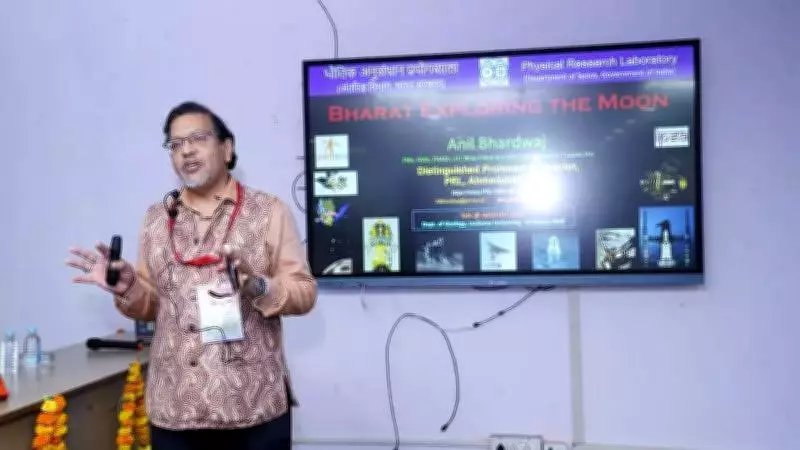
In a significant revelation about India's space ambitions, Anil Bhardwaj, director of the Physical Research Laboratory (a unit of the Department of Space), stated on Saturday that the possibility of India establishing a scientific base on the moon in the next five decades may become a reality. This announcement highlights the country's long-term commitment to lunar exploration and space science.
Geocon-2026 Conference Insights
Bhardwaj was speaking to TOI on the sidelines of the conference titled 'Geocon–2026: Sustainable Environment for Geoscience and Climate Change,' which was organised by the Department of Geology at Lucknow University. During his address, he emphasized India's progressive steps in space technology and lunar missions.
Chandrayaan-4 Mission Details

Bhardwaj, who also delivered a lecture on 'Indian Lunar Exploration Programme - Past, Present and Future,' provided specific details about upcoming missions. He revealed that the Chandrayaan-4 mission is expected to be launched around 2028-29. "It will focus on bringing lunar soil and rock samples back to Earth, which will help scientists study the Moon's composition and geological history in greater detail," he explained. This mission aligns with global efforts, as recent international media reports indicate that NASA is developing plans to establish a permanent base on the moon in the coming years for astronaut experiments.
Scientific Discoveries and Technological Advances
Referring to the Antarctic meteorite ALH 81005, Bhardwaj noted, "ALH 81005 is considered one of the earliest lunar fragments discovered on Earth. Scientists observed similarities between the lunar materials studied during the Chandrayaan-3 mission and the composition found in this meteorite." This connection underscores the value of India's lunar research in understanding celestial bodies.
The Physical Research Laboratory plays a crucial role in this endeavor by conducting scientific research, analyzing space data, and developing instruments used in satellites and planetary missions of the Indian Space Research Organisation (ISRO). Bhardwaj highlighted ISRO's SpaDeX mission, which demonstrated how two satellites launched by a PSLV approach each other in orbit, dock together, and later separate. "Such technology is crucial for building space stations, refuelling spacecraft, and conducting complex space missions," he said.
Future Lunar Missions and Goals
Looking ahead, Bhardwaj outlined ambitious plans for Chandrayaan-5, which will explore the moon's permanently shadowed polar regions. These areas, where sunlight never reaches, may contain traces of water ice, a resource vital for sustaining human presence. Future missions may include a crewed orbiter followed by a mission that could land an Indian astronaut on the moon by around 2040.
Long-Term Lunar Infrastructure
To support these efforts, India is exploring innovative concepts such as a lunar navigation system similar to GPS and in-situ resource utilisation (ISRU) technology. ISRU aims to use lunar resources, like water ice, for sustaining human presence on the moon, reducing reliance on Earth-based supplies. Bhardwaj's statement about establishing a scientific base on the moon in the next 50 years reflects a strategic vision to enhance India's capabilities in space exploration and contribute to global scientific knowledge.
This comprehensive approach, combining immediate missions like Chandrayaan-4 and Chandrayaan-5 with long-term goals, positions India as a key player in the new era of lunar exploration and space technology development.