In a shocking revelation, government hospitals across Rajasthan have consistently failed to follow crucial safety protocols mandated for blood transfusions, a directive issued nearly a decade ago. This systemic negligence has resulted in multiple cases where patients received the wrong blood type, putting lives at serious risk.
Decade-Old Directives Gather Dust
The Rajasthan State Human Rights Commission (RSHRC) had issued clear guidelines back in 2015 to ensure error-free and safe blood transfusions in all state-run medical facilities. The commission's directive included specific identification protocols, such as tying a detailed information ribbon on the patient's hand and meticulously recording the details of every individual involved in the blood collection and transfusion process.
Despite these explicit instructions, a recent incident at PBM Hospital in Bikaner on December 17 exposed the ongoing lapses. A patient was administered the wrong blood type, highlighting a dangerous pattern of neglect. Over the past two years alone, at least five such cases of incorrect blood transfusion have been officially reported, suggesting the problem is widespread.

What the Safety Protocol Mandates
The RSHRC's 2015 order outlined a rigorous chain of responsibility to prevent fatal errors. Key measures include:
- Assigning doctors, wherever possible, for the task of sending samples to the blood bank and collecting blood from there.
- Recording the names of the sample depositor, the blood collector, and the transfusing doctor in the patient's bed head ticket.
- Making it mandatory for the doctor to personally verify that the blood unit matches the patient's sample before transfusion and to document this verification in the same ticket.
- Holding hospital superintendents ultimately responsible for ensuring a completely error-free transfusion process.
However, routine procedures in government hospitals continue to overlook these vital safety checks, operating on a casual approach that endangers patients.
Wake-Up Call and New Warnings
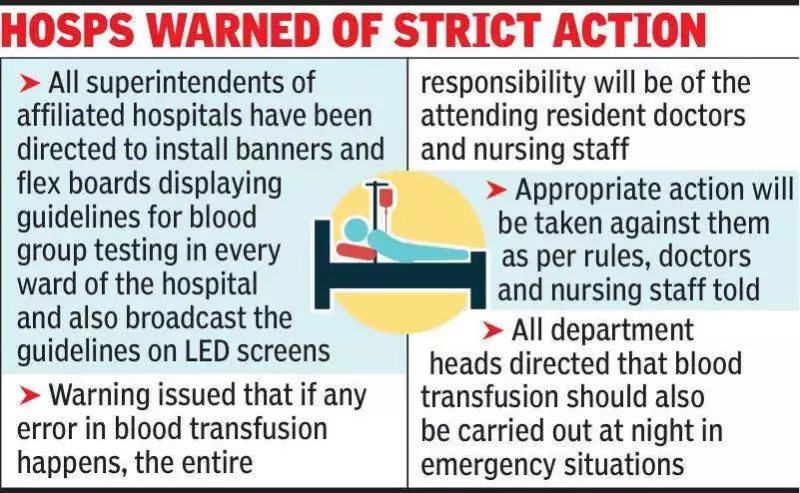
The Bikaner incident finally spurred authorities into action. The SP Medical College has now issued fresh, strict directions to all associated departments to fully implement the 2015 RSHRC guidelines without any delay.
"We have directed all departments to fully implement in their respective departments the necessary guidelines issued by RSHRC for safe blood transfusion," confirmed a senior official from SP Medical College.
In a significant move, all department heads have been explicitly warned that they will be held personally accountable if any error is found in the blood transfusion process within their units. They have been instructed to conduct immediate meetings with resident doctors, nursing staff, attendants, and lab technicians to ensure everyone is bound to follow the safety protocols.
This belated crackdown underscores a tragic reality: a simple adherence to established rules could have prevented multiple life-threatening incidents over the years. The health administration's failure to enforce these directives has compromised patient safety in Rajasthan's public healthcare system.