

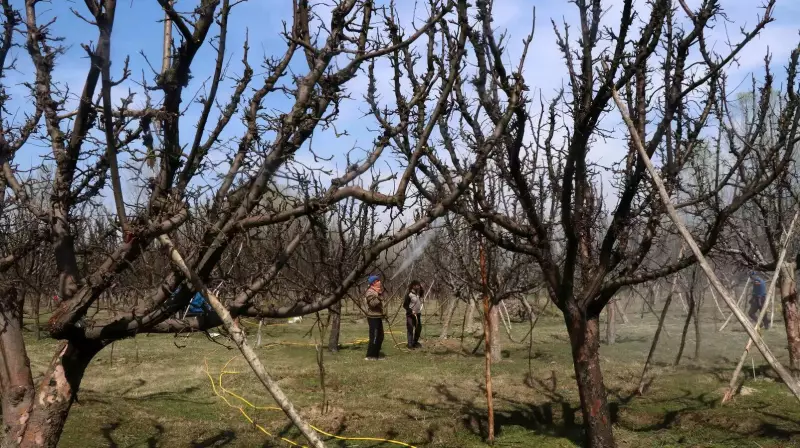
In a development that strikes at the heart of Kashmir's rural economy, the region's iconic apple orchards have come under intense scrutiny. Lawmakers and medical experts are raising urgent alarms over a potential connection between prolonged pesticide use and a disturbing rise in malignant brain tumours among orchard workers and residents.
Assembly Committee Sounds the Alarm
The House Committee on Environment of the Jammu and Kashmir assembly, led by CPM legislator MY Tarigami, has taken serious note of the emerging health crisis. The committee recently convened with officials, scientists, and health experts to examine the grave hazards faced by those working in the Valley's apple orchards, which form the backbone of its rural economy and contribute over 70% of India's total apple production.
"For years, farmers have sprayed orchards unaware of the toxicity of constant pesticide exposure," the committee stated. This practice is now linked to a rise in malignant brain tumors among the very people who power the valley's billion-rupee apple industry.

Disturbing Evidence from Medical Research
The discussions brought back into focus a pivotal study conducted by the Sher-i-Kashmir Institute of Medical Sciences (SKIMS). The research, which examined over 400 cancer patients between 2005 and 2008, reported high incidences of primary brain cancer in the core fruit belt districts: Baramulla, Anantnag, Budgam, Shopian, and Kupwara.
The study identified a "quite strong and possible" link between pesticide exposure and these aggressive tumours. Although initially overlooked, these findings have gained renewed urgency amid growing medical evidence of pesticide-linked disorders in the Valley.
"We don't want to create panic among farmers who spray their orchards every season. But neither can we sit idle when data indicates a serious health hazard," MY Tarigami told The Times of India. "If pesticide spray is harming lives, it must be addressed."
Overuse of Chemicals and Lack of Protection
Scientists informed the committee that pesticide application in apple orchards frequently exceeds recommended limits. Shahid Rasool, principal scientist at CSIR–Indian Institute of Integrative Medicine, explained that many orchardists spray chemicals every 10 to 12 days instead of the advised 18 to 21, mistakenly believing it increases yield.
"Few can afford protective gear; chronic cough, rashes and irritation are common. Without gloves, goggles and masks, the risk multiplies," he warned. Rasool noted that orchardists now use up to 15 rounds of fungicide and insecticide each season, far beyond recommended schedules, and called for immediate adoption of safer practices and protective equipment.
Pesticide Traces Found in Human Bloodstream
Further deepening concerns, Dr. Sobia Nisar, a physician-researcher at Government Medical College, Srinagar, presented alarming findings from her work in apple-growing districts like Shopian and Pulwama. Her research, initially aimed at checking pesticide residue in fruit, uncovered something far more disturbing: traces of these toxic compounds in human blood samples.
Her work documents pesticide residues in the bloodstream of orchard workers and nearby residents, correlating with higher rates of obesity, lipid disorders, metabolic syndrome, and early kidney impairment. "When such patterns emerge consistently across populations exposed to pesticides, it demands urgent scientific scrutiny," Dr. Nisar emphasized.
Detailed Study Points to Occupational Hazard
A detailed study titled "Pesticides and brain cancer linked in orchard farmers of Kashmir" provided stark data. It analyzed records of 432 patients with primary malignant brain tumours and 457 control patients treated at SKIMS between 2005 and 2008.

The analysis found that a staggering 90.04% of brain tumour patients (389 out of 432) were orchard farm workers, residents, or children exposed to orchard pesticides for over 10 to 20 years. Of these, 71.7% were male and 28.3% female, and nearly a third (31.9%) were under 40 years old, indicating early-age exposure.
All orchard-related patients had high-grade, aggressive tumours. The patients had been exposed to multiple neurotoxic chemicals like chlorpyriphos, dimethoate, mancozeb, and captan. Mortality among pesticide-exposed tumour patients was recorded at 12%.
Statistical analysis showed a significant case-control odds ratio, pointing to what researchers called a strong suspicion of a link between pesticide exposure and brain cancer.
Wider Environmental Impact and Call for Action
The study highlighted that millions of tonnes of pesticides are sprayed annually across Kashmir's orchards. With apple cultivation covering more than half of the Valley's fruit-growing land, around 40% of the population is directly or indirectly exposed through farming, residence near orchards, or recreational use of these spaces.
The House Committee on Environment has stated it will recommend concrete measures to the health and horticulture departments. These will focus on enhanced monitoring, dedicated research funding, and stringent worker safety protocols, as concerns over the long-term health impact of pesticide use reach a critical point.
The situation presents a formidable challenge: safeguarding the health of the community that sustains Kashmir's most vital agricultural economy, while ensuring the industry's future remains secure.





