

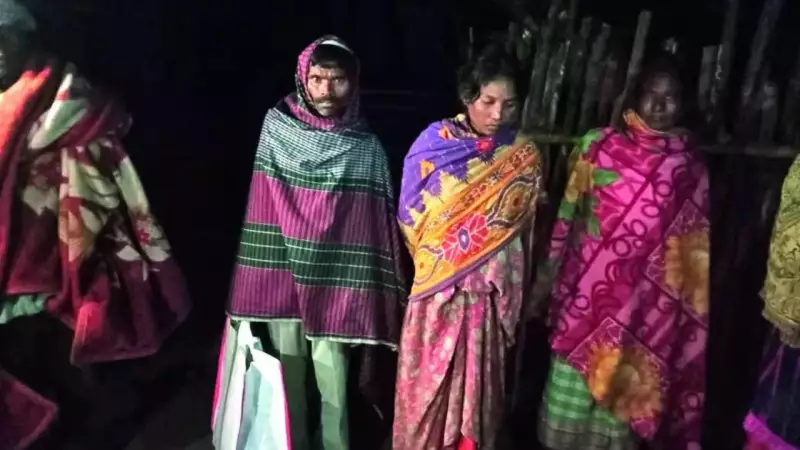
A chilling scene unfolded outside a government hospital in Jharkhand's Chaibasa as a young father, with no means left to save his child, began a heartbreaking journey home. With his four-month-old son's body tucked inside a plastic grocery bag, Dimba Chataumba boarded a public bus for a 70-kilometer trip, a stark testament to the systemic failures plaguing public healthcare and transport for India's poor.
A Father's Desperate Plea and a System's Failure
Dimba Chataumba, a resident of the remote Baljori village in West Singhbhum district, had brought his infant son, Krishna, to the Chaibasa sadar hospital. The child was suffering from high fever, loose motions, and breathing difficulties. Medical tests confirmed malaria, and doctors diagnosed the baby as severely anaemic and in critical condition, requiring ventilator support beyond the hospital's capacity.
On Thursday evening, doctors advised Chataumba to transfer Krishna to the advanced Mahatma Gandhi Memorial Medical College & Hospital in Jamshedpur, located 70 km away. However, the referral came with an insurmountable hurdle: cost. Chataumba pleaded with the hospital staff, explaining he had no money for private transport to make the journey. With no alternative, treatment continued at Chaibasa with oxygen and medicines, but Krishna's condition deteriorated. By Friday afternoon, the infant succumbed.

The 70-Kilometer Journey in a Plastic Bag
Grief was swiftly overtaken by a grim urgency. Chataumba, with only Rs 100 in his pocket, requested a shav vahan (hearse ambulance) to take his son's body home to Baljori. Hospital officials asked him to wait, stating their only functional ambulance was near Manoharpur, roughly 80 km from Chaibasa. After waiting for over two hours with no vehicle in sight, Chataumba made a silent, agonizing decision.
He left the hospital premises, purchased a thick plastic bag from a nearby shop, and carefully placed the 3.6 kg body of his son inside. Without informing any staff at the paediatric ward or the hospital guard, he walked to the bus stop and began the long journey home via public transport. "He quietly left the hospital. We all were in the dark," said district civil surgeon Dr. Bharti Gorreti Minz.
A Recurring Tragedy Across India's Healthcare Landscape
By the time Chataumba reached his village, his ordeal had spread shock among neighbours. An inquiry ordered by the administration later noted that the father had left hastily. The report by Chaibasa sub-divisional officer Sandeep Anurag Topno stated that Chataumba could not be contacted when the ambulance eventually arrived because he did not own a mobile phone.
Tragically, this incident is not isolated. It echoes a persistent national crisis:
- In September 2024, a couple in Maharashtra walked through a muddy forest path carrying the bodies of their two sons after fever claimed their lives and no vehicle was provided.
- In June 2025, a tribal man in Nashik travelled 90 km by bus with his newborn's body in a bag after a civil hospital refused an ambulance.
- Jharkhand's own High Court recently sought explanations from the state after videos surfaced of a man carrying his sick wife on his shoulder in the absence of an ambulance.
- The memory of Dana Majhi from Odisha, who walked 12 km with his wife's body in 2016, remains a painful symbol of this ongoing failure.
For families like Chataumba's in Baljori—a village nestled in forested hills and mining belts near the Odisha border—accessing healthcare is a monumental challenge. Sparse public transport and expensive private vehicles mean a hospital visit often leads to debt, and a referral to a city hospital can feel like a surrender. This latest incident in Chaibasa underscores how, despite previous outcries, the lessons for robust last-mile healthcare and dignified transport for the deceased remain unlearned, leaving the most vulnerable to fend for themselves in their darkest hours.






