

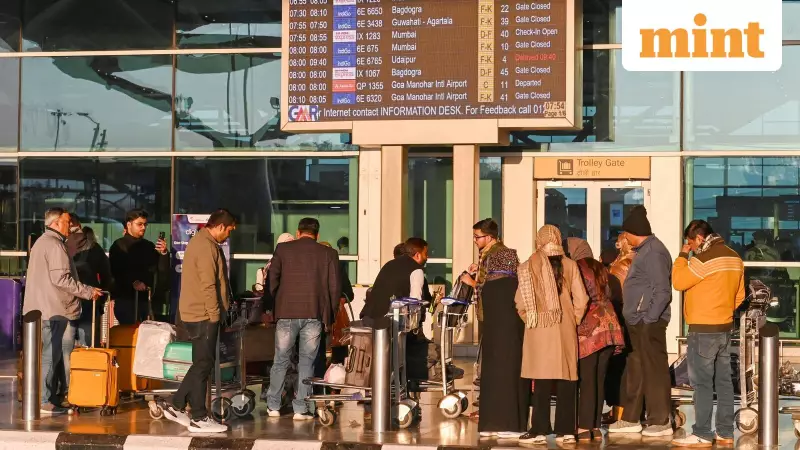
Thick, hazardous smog descended upon Delhi and the wider National Capital Region (NCR) on Wednesday morning, drastically reducing visibility and throwing daily life and travel into disarray. The dense fog blanket severely impacted road and air traffic, with flight operations at the Indira Gandhi International (IGI) Airport facing significant disruptions.
Flight Operations Hit by Dense Fog
Airport authorities confirmed that due to the intense fog, all flight movements are being conducted under CAT III conditions, a protocol for very low visibility. This has inevitably led to numerous delays and cancellations, causing inconvenience to hundreds of passengers. In an official advisory, Delhi Airport stated that its ground teams are deployed across terminals to assist travelers during these challenging conditions.
The airport's advisory clearly mentioned, "Due to prevailing dense fog conditions, flight operations are currently being conducted under CAT III protocols, which may result in delays or cancellations. Our ground teams are on-site and actively assisting passengers to ensure a smooth travel experience. We regret the inconvenience caused." Passengers have been strongly advised to contact their respective airlines for the most current flight information before heading to the airport.

How to Check Your Flight Status and Contact Airport
For real-time updates, passengers can use the Delhi Airport's official Live Flight Information portal at www.newdelhiairport.in/winter-travel. By entering their flight number and travel date, they can access live data on:
- Current flight status (On-time, Delayed, Cancelled)
- Assigned terminal and gate information
- Scheduled versus estimated arrival/departure times
For general queries, domestic callers can reach the airport at 0124-4797300 or 0124-6838410, while international callers should dial +91-124-4797300 or +91-124-6838410. Flight information can be obtained by calling +91-011-61234567.
Ministry and Airlines Issue Urgent Advisories
The Ministry of Civil Aviation took to social media platform X to alert the public about the situation. "Prevailing fog conditions in parts of Northern India may impact flight operations at select airports. Passengers are encouraged to remain updated through official airline channels and allow extra time for airport procedures," the ministry posted. It further instructed all airlines to strictly follow passenger service norms, including providing timely updates, assistance during delays, and facilitating rebooking, refunds, and baggage handling.
Major carrier IndiGo also issued a travel advisory, noting that visibility remains reduced and flight movements are slower than normal. "We will continue to manage operations under the prevailing conditions, sequencing departures and arrivals to maintain orderly operations," the airline stated. It urged passengers to check their flight status online and, considering poor road visibility, to allow extra time for their journey to the airport.
Air Quality Plummets to 'Severe' Levels
The foggy conditions coincided with dangerously high pollution levels across the capital. Visuals from areas like Ghaziabad's Indirapuram, Noida's Botanical Garden, and Delhi's Akshardham showed a thick grey layer enveloping roads and buildings, forcing vehicles to crawl. According to the Central Pollution Control Board (CPCB), Delhi's overall Air Quality Index (AQI) at 7 am was 384, placing it in the 'very poor to severe' category.
Several monitoring stations recorded AQI levels deep in the 'severe' zone, posing serious health risks:
- Anand Vihar: 452
- ITO: 426
- RK Puram: 411
- Chandni Chowk: 419
- Dwarka Sector 8: 414
Other areas, including IGI Airport (T3) at 334, Najafgarh at 331, and Aya Nagar at 321, recorded AQI levels categorized as 'very poor'. The combination of dense fog and toxic pollutants created a double challenge for residents and authorities alike, highlighting the ongoing environmental crisis faced by the region during winter.






