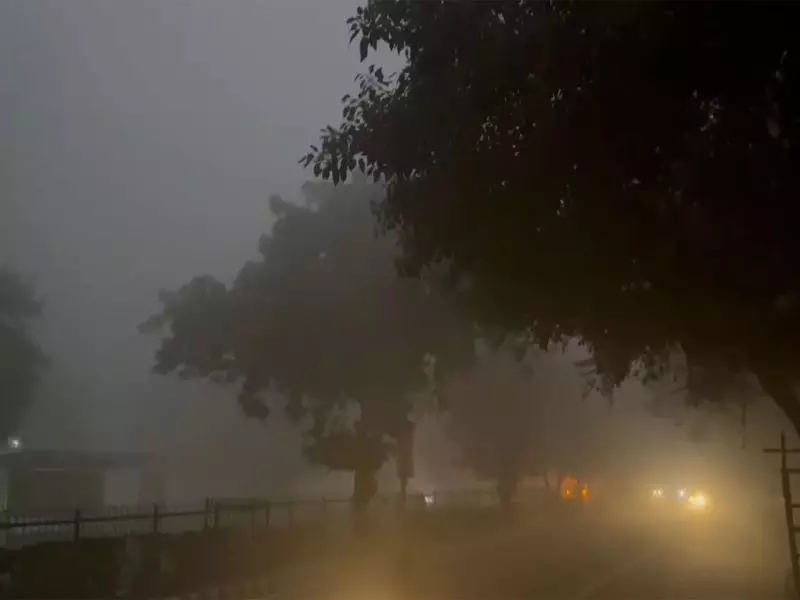
Delhi and its surrounding regions woke up to a hazardous blanket of thick fog and severely polluted air on Wednesday morning, creating a dual environmental crisis that disrupted daily life and raised significant health concerns. The national capital's air quality index (AQI) plummeted into the 'severe' category, marking one of the worst episodes of the winter season.
Visibility Plummets and Air Turns Toxic
The India Meteorological Department (IMD) reported that dense fog severely reduced visibility across the city. At the Palam Observatory, near the Indira Gandhi International Airport, visibility dropped dramatically to a mere zero meters between 5:30 am and 7:30 am. Conditions improved only slightly later, with visibility rising to 50 meters by 8:30 am. The Safdarjung observatory recorded visibility at 200 meters during the same early morning period.
Simultaneously, the air quality took a dangerous turn. Data from the Central Pollution Control Board (CPCB) revealed that the overall AQI for Delhi stood at 463, deep in the 'severe' zone. The situation was particularly dire in specific neighborhoods. Anand Vihar recorded a staggering AQI of 499, while the IGI Airport (T3) area registered 477. Other severely affected locations included Bawana (485), RK Puram (478), and Punjabi Bagh (475).
Immediate Impact on Transport and Daily Life
The combination of near-zero visibility and toxic air had an immediate and tangible impact. Flight operations at Delhi's international airport faced significant delays and disruptions. Authorities were forced to implement Category III (CAT III) landing procedures, a specialized system that allows aircraft to land in extremely low visibility conditions. Despite this, several flights were delayed, and a few were diverted to other cities, causing inconvenience to hundreds of passengers.
Road and rail transport were also hit. Vehicles were compelled to move at a crawl with their hazard lights on, leading to major traffic snarls on key highways and within the city. Train schedules were similarly affected, with many services running late due to the reduced visibility.
Official Response and Health Warnings
In response to the escalating crisis, the Commission for Air Quality Management (CAQM), the central government's pollution control body, has intensified its actions under the Stage III Graded Response Action Plan (GRAP). This stage is activated when the AQI is projected to cross the 'severe' threshold. Key measures include a strict ban on most construction and demolition activities across the National Capital Region (NCR), with exemptions only for essential projects.
Health experts and authorities have issued urgent advisories, especially for vulnerable groups. The elderly, children, and individuals with pre-existing respiratory or heart conditions have been advised to avoid all outdoor activities and strenuous exercise. The general public has been urged to limit time spent outside, wear N95 or equivalent masks when going out, and keep medications for conditions like asthma readily available.
The Delhi government is closely monitoring the situation, with discussions ongoing regarding potential further measures, including the possibility of shifting primary schools to online classes to protect young children from exposure to the hazardous air.
Meteorologists attribute the severe conditions to a combination of factors: very low wind speeds that prevent the dispersal of pollutants, high humidity levels leading to fog formation, and a sharp drop in temperature. With similar weather conditions forecast for the coming days, residents of Delhi-NCR are bracing for a prolonged period of poor air quality and visibility issues, underscoring the persistent and severe nature of the region's winter pollution crisis.