

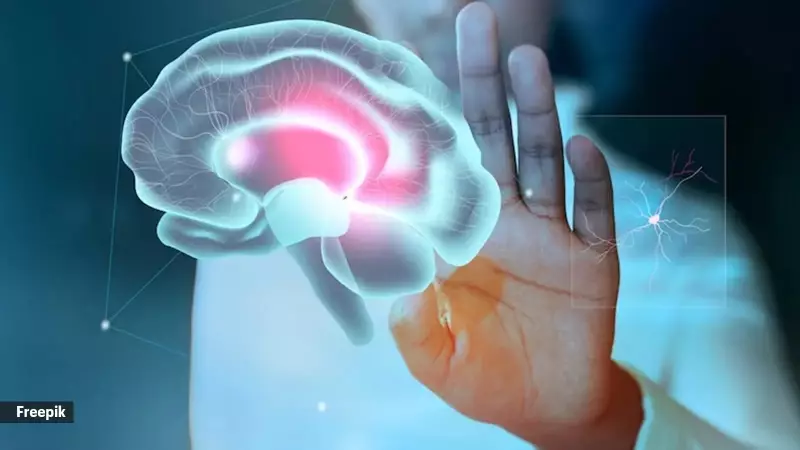
A simple yet baffling physical challenge is taking social media by storm, leaving most users stumped and revealing fascinating insights into how our brains are wired. Known as the 'Foot and 6' trick, it asks a seemingly straightforward question: Can you rotate your right hand clockwise while simultaneously rotating your right ankle in the opposite, counter-clockwise direction?
The Science Behind the Struggle
Neurosurgeon Dr Arun L Naik recently brought this viral neuroscience puzzle into the spotlight on Instagram. He explained that successfully performing both opposing movements at once is a rare feat, achieved by only about five per cent of the population, whom he playfully dubs "superbrainers."
"For most people, the foot suddenly flips direction without permission," Dr Naik noted. "This isn't a mistake — it's your brain short-circuiting." The core reason lies in our brain's anatomy. The right hand and right foot are primarily controlled by overlapping areas in the brain's left motor cortex. When you command this single hemisphere to execute two contradictory rotation programs simultaneously, internal conflict arises.

Dr Sheetal Goyal, a Consultant Neurologist at Wockhardt Hospitals, Mumbai Central, elaborated on this neural tug-of-war. "The supplementary motor area, which plans complex movements, tries to manage both actions. Meanwhile, the cerebellum, responsible for smooth coordination and error correction, steps in to resolve the mismatch," she said.
Why Your Hand Always Wins
The outcome of this internal conflict is almost always predictable: the foot surrenders to the hand. Dr Goyal clarified that because hand movements are typically more precise and dominant in our daily activities, the brain unconsciously prioritizes them. "The brain unconsciously adjusts the foot to follow the hand’s direction. This switch happens automatically, without conscious awareness," she explained.
This automatic correction is a sign of an efficient, normally functioning nervous system. Failing the challenge is not linked to intelligence, reflexes, or brain health. "The brain prioritises efficiency over performing conflicting tasks at the same time. It’s simply how the nervous system is designed to work," Dr Goyal stressed, assuring that there is no cause for concern if you cannot do it.
Who Are the 'Superbrainers'?
So, who comprises that elite five per cent who can ace the challenge? According to Dr Goyal, this ability is less about innate superiority and more about refined motor control developed through extensive practice. It is frequently observed in individuals with professions or hobbies that demand high levels of bodily coordination.
"This is often seen in individuals with extensive motor training, such as dancers, musicians, or athletes," she said. "It reflects refined motor control and practice rather than a ‘super brain’ or superior intelligence."
A Different Challenge for Left-Handed People
The challenge adapts for left-handed individuals. For them, the conflict is created by trying to rotate the left foot anti-clockwise while the left hand draws a circular number '9' in the air. This reversal accounts for the different patterns of motor dominance often seen in left-handed people, creating a similar neural conflict on their dominant side.
Ultimately, experts emphasize that this viral trend is a fun demonstration of neuroscience principles. It is not a diagnostic or medical test. It's a playful reminder of the brain's incredible, efficiency-driven design, which usually works so seamlessly that we only notice its complex wiring when we ask it to work against its own ingrained patterns.






