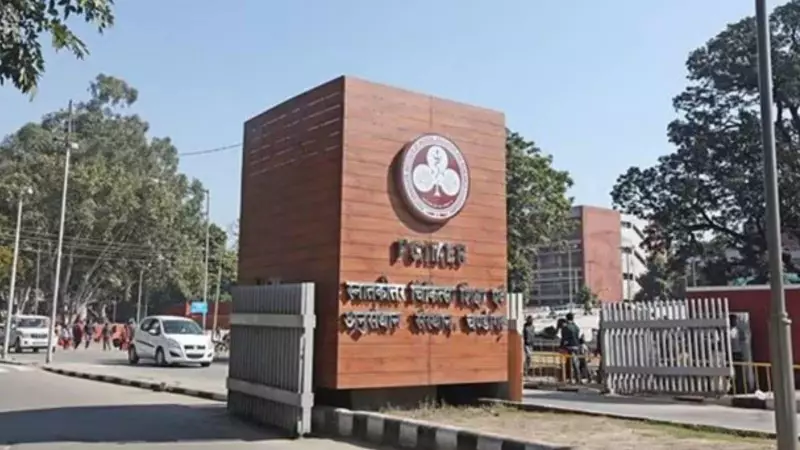
The Central Bureau of Investigation (CBI) has registered a major fraud case involving the diversion of funds meant for critically ill and impoverished patients at the Postgraduate Institute of Medical Education and Research (PGIMER) in Chandigarh. A preliminary enquiry has exposed a well-coordinated racket, amounting to Rs 1.14 crore, which allegedly operated with the help of a photocopy shop located inside the hospital campus.
The Core of the Conspiracy: A Photocopy Shop's Role
According to the CBI's findings, the fraud was centered around the Private Grant Cell (PGC) of PGIMER, which handles donations from entities like the Prime Minister’s National Relief Fund (PMNRF) and the Rashtriya Arogya Nidhi. Officials in the PGC allegedly bypassed all standard procedures. They created fake claim files and showed private individuals as dependents of genuine patients.
The money was then routed to bank accounts arranged through a photocopy shop operating at the Gol market within the PGIMER campus. The shop's owner, Durlabh Kumar, and his partner, Sahil Sood, were in constant touch with PGC officials. They facilitated these conduit bank accounts, allowing the siphoned funds to be credited and later diverted to the accused and their associates. Medicines bought with the grant money were also allegedly sold illegally in the open market using forged supply orders.

How the Elaborate Fraud Was Uncovered
The scam first came to light in a poignant case. The husband of a beneficiary, Kamlesh Devi, approached the PGC to obtain medicines against a sanctioned grant of Rs 2,50,000. Upon verification, it was discovered that the manual file was destroyed, the digital record deleted, and a sum of Rs 2,01,839 had already been transferred via RTGS to the bank account of one Niwas Yadav, who had no connection to the patient.
In another instance, Rs 90,000 from a grant for patient Arvind Kumar was transferred to the account of a PGIMER employee named Neha. These glaring anomalies prompted PGIMER to initiate an internal probe, headed by Professor Dr. Arun Kumar Aggarwal.
Findings of the Internal Probe and Digital Manipulation
The internal committee uncovered widespread manipulation. It found that mandate forms of 11 individuals, who were neither patients nor their dependents, were fraudulently obtained by PGC officials. Using these forged documents, payments worth Rs 19,00,759 were processed.
The probe delved into grants for rare disease patients, revealing that out of Rs 61.75 lakh received for five patients, Rs 38,00,946 was transferred to medicine suppliers without any prescription slips. Shockingly, two of these five patients were already deceased, yet payments totalling Rs 27,66,355 were released to firms.
An examination of records from 2017 to 2021 revealed 70 more cases of irregularities. In 17 cases, original bills were manipulated for double payments. Original files for 37 patients were missing. Analysis of the database server showed officials intentionally deleted patient data and manipulated supply orders by inserting false entries.
Legal Action and Ongoing Investigation
Based on a complaint from PGIMER's Chief Vigilance Officer (CVO), the CBI registered an FIR on December 20, 2025. The agency has booked six current and former PGIMER employees and the two private individuals from the photocopy shop.
The accused have been charged under sections 120-B (criminal conspiracy), 406, 409 (criminal breach of trust), 420 (cheating), and 471 (using forged documents) of the Indian Penal Code, along with relevant sections of the Prevention of Corruption Act. The role of other unknown public servants and private persons remains under the scanner.
The CBI enquiry concludes that this was a "well-organised criminal conspiracy" designed to deceive approving authorities, manipulate digital records, and ultimately divert precious public funds meant for society's most vulnerable away from their intended purpose.