

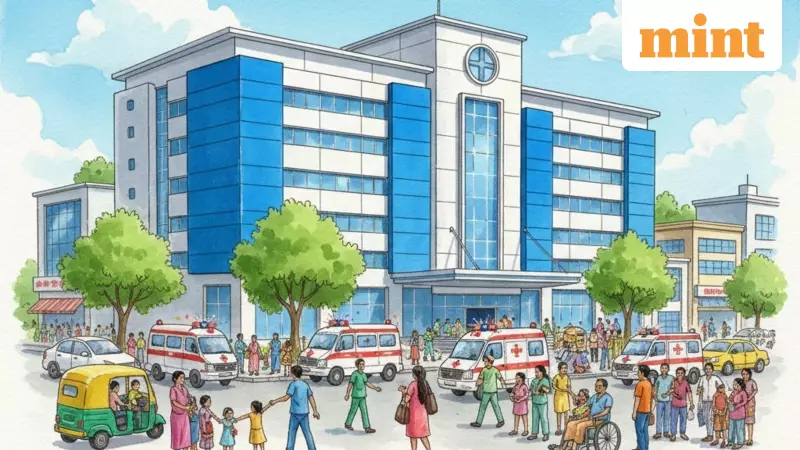
India's private healthcare landscape is witnessing a fascinating dual trend. While large national hospital chains are consolidating to build pan-India networks, a wave of mid-tier corporate hospital groups is aggressively expanding to solidify their positions as regional leaders. This strategic scaling up, experts suggest, could eventually make these regional players attractive acquisition targets for the bigger giants.
The Expansion Blueprint: Greenfields, Beds, and Capex
The mid-tier chains are primarily fueling their growth through greenfield projects and capacity expansion in existing facilities. This expansion is largely funded by internal accruals and debt, capitalizing on the increasing demand for private healthcare and the rapid penetration of health insurance across the country.
The opportunity is vast. Ram Panda, managing director of healthcare and life sciences at Alvarez & Marsal India, points out that the top 20 organized players hold less than 15% of the healthcare delivery market. This leaves significant room for regional chains to grow, especially in under-penetrated tier-II and tier-III cities.

Here is a snapshot of the expansion activities underway:
Jupiter Life Line Hospitals is deepening its roots in Maharashtra. The chain plans to add around 1,440 beds in Pune and Thane over the next three to four years, aiming for a total capacity of 2,500 beds. This ambitious plan is backed by a capital expenditure (capex) of ₹1,400 crore.
Paras Hospitals, which is preparing for an initial public offering (IPO), is targeting north India's tier-II and tier-III cities. The Gurugram-headquartered chain has new units planned for Gurgaon, Ludhiana, and Panchkula.
Krishna Institute of Medical Sciences (KIMS) from Telangana is spreading its wings beyond its home state. It recently opened a 300-bed hospital in Thane and a 450-bed facility in Bengaluru. Overall, KIMS has announced a bed ramp-up of over 1,600 beds with an approximate capex of ₹1,060 crore.
Other notable expansions from the last two years include Artemis Hospitals scaling its Gurgaon capacity to 700 beds and planning new units in Raipur and South Delhi. Tamil Nadu's Kauvery Hospitals has outlined plans to add 3,500 beds across South India with a ₹3,000 crore capex.
Organic Growth vs. The Acquisition Route
While many mid-tier players prefer organic, greenfield expansion, some are also exploring mergers and acquisitions (M&A) to scale quickly. Ujala Cygnus from New Delhi acquired a stake in Punjab's Amandeep Hospitals in April, boosting its bed capacity from 2,000 to 2,800. Similarly, Chennai's MGM Healthcare expanded its Southern footprint by acquiring Visakhapatnam's SevenHills Hospital and Fortis Malar in Chennai during 2024.
However, the preference often leans towards building from scratch. Dr. Ankit Thakker, joint MD and CEO at Jupiter Life Line Hospitals, explained the rationale. An acquisition, while faster, risks compromising on ideal location, design, technology, and team culture. "In a greenfield model, the only compromise I have to make is speed. I have to wait for three years longer," he noted.
This strategy of "concentric expansion"—strengthening the core region before widening the net—is common. Paras Hospitals sees a clear gap in tier-II and tier-III cities of North India. Vineet Aggarwal, Group COO of Paras, observed that while tier-I cities are crowded with hospitals, patients from smaller cities are often forced to travel for quality treatment, creating a compelling opportunity.
Setting the Stage for Future Consolidation
This aggressive expansion by mid-tier chains is not happening in isolation. Top players like Apollo Hospitals, Manipal Hospitals, and Max Healthcare are also on a growth spree to become pan-India entities. For instance, Apollo is investing ₹8,000 crore to add 4,300 beds in key cities.
The sector is attracting significant investor interest. In just the last quarter, the hospital sector saw 19 deals worth $264 million, according to Grant Thornton Bharat. Major deals like Manipal's acquisition of Sahyadri Hospitals and the merger of Aster DM with Quality Care India highlight the consolidation trend.

Experts believe the current expansion by mid-tier chains is laying the groundwork for the next wave of sector consolidation. Mayur Sirdesai, partner at Somerset Indus Capital Partners, said, "Today, even the mid-level chains are seeing expansion potential. So they will expand. At some point, they could be bought over by a [larger chain]." Acquiring an established regional model is often easier for a national player than building one from scratch in a new geography.
Ram Panda of Alvarez & Marsal added that as these mid-tier chains scale up, they will attract increasing interest from both private equity firms and strategic buyers. The driving forces behind this entire growth cycle—rising incomes, higher insurance penetration, and a significant demand-supply gap—ensure that India's healthcare delivery story has many more chapters to be written.





