Historic Bone Transplant at Kolkata Hospital Uses Eastern India's Only Bone Bank
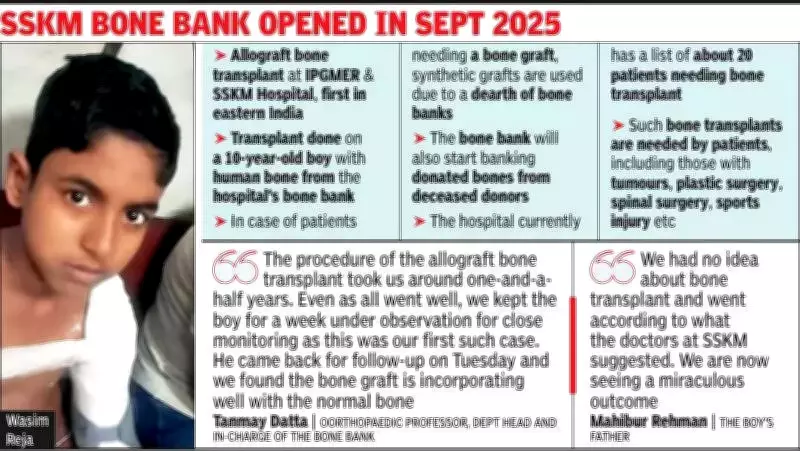
In a groundbreaking medical achievement, doctors at the state-run IPGMER & SSKM Hospital in Kolkata have successfully conducted a bone transplant on a 10-year-old boy from Murshidabad. This landmark procedure represents the first time the hospital has utilized donor bone from its own bone bank, which is not only the sole facility of its kind in eastern India but also among a select few across government institutes nationwide.
Patient's Journey and Medical Procedure
The young patient, Wasem Reja, had been suffering from persistent swelling and pain around his left shoulder, severely restricting his movement. After initial consultations in Berhampore yielded no improvement, his family brought him to SSKM Hospital, where orthopaedic specialists diagnosed a tumour in the proximal humerus bone—the critical bone connecting the upper arm to the shoulder and forearm.
In January of this year, surgeons operated to remove the tumour, a procedure that inevitably left a cavity in the bone. To address this, the orthopaedic department opted for a bone transplant, filling the cavity with donor bone from their newly functional bone bank. From an inventory of 29 pieces, doctors meticulously selected three that underwent rigorous testing, including gamma sterilisation and microbiology checks, to ensure they were infection-free.

On March 11, the transplant was performed using approximately 20 grams of bone. The boy was discharged after a week of close observation, with follow-up visits confirming successful integration of the graft with his natural bone.
Expert Insights and Patient Outcomes
Professor Tanmay Datta, head of the orthopaedic department and in charge of the bone bank, explained the significance of this case. "The allograft bone transplant procedure took us around one-and-a-half years to perfect. Although everything went smoothly, we kept the boy under observation for a week as this was our inaugural case. His recent follow-up showed the bone graft is incorporating well, with normal blood supply, no swelling, and complete relief from pain," he stated.
Datta emphasized the urgency of the treatment: "The tumour was benign but highly aggressive. Without intervention, it could have worsened, increasing pain and swelling. Leaving the bone cavity unfilled would have compromised hand function over time, making daily tasks a struggle."
The boy's father, Mahibur Rehman, a civic volunteer from Rejinagar, expressed his gratitude. "We had no prior knowledge of bone transplants but trusted the doctors' advice. The outcome has been miraculous—my son is now pain-free, and we expect further improvement soon," he shared.
Eastern India's Pioneering Bone Bank
The bone bank at SSKM Hospital was inaugurated by West Bengal Chief Minister Mamata Banerjee in September last year. It stands as eastern India's first such facility and joins elite institutions like AIIMS Delhi and Tata Memorial Hospital Mumbai in offering this critical resource. While private bone banks exist, patients typically must purchase bone through hospitals where transplants are planned, making this public initiative a vital advancement.
Since its launch, the bank has begun collecting bones that are typically discarded as biomedical waste, such as those from total hip and knee replacement surgeries, with donor patient consent. This approach not only reduces waste but also provides a superior alternative to synthetic grafts, which were previously used in the absence of a bone bank.
Professor Datta highlighted the advantages: "Natural human bones offer better healing and graft outcomes compared to synthetic options. While living donor transplants are possible, they carry risks of donor morbidity, making banked bones a safer choice."
Future Expansion and Impact
To meet growing demand, the bone bank is exploring plans to bank donated cadaver bones, with discussions underway involving ROTTO (East), SOTTO, and state health officials. Currently, the orthopaedic department has 15 patients listed for bone transplants, and the bank aims to serve not only its own patients but also those from other hospitals upon requisition and health department approval.

An official from IPGMER & SSKM Hospital noted, "Initially, we will focus on our patients' needs, but we are prepared to expand services to other hospitals as permitted by the health department." This development marks a significant step forward in regional healthcare, potentially benefiting countless patients in need of bone transplants across eastern India.