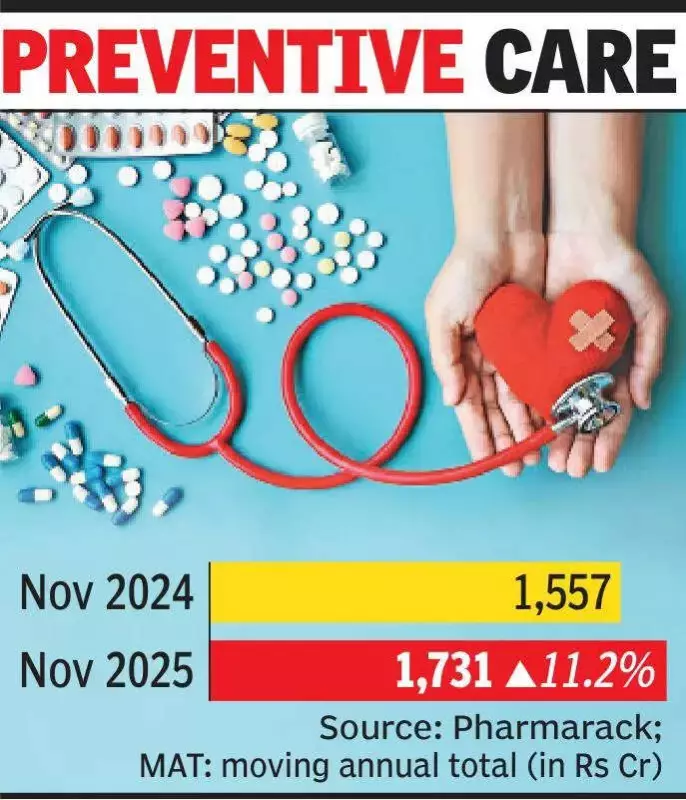
The market for drugs used to treat cardiovascular diseases (CVD) in Gujarat has witnessed a significant surge, growing by 11% over the past year. This growth, however, is not merely a reflection of rising heart problems but signals a fundamental change in how doctors across the state are treating patients to prevent long-term damage.
A Shift in Strategy: From Acute Events to Chronic Control
Data from healthcare platform Pharmarack reveals that the moving annual total (MAT) for cardiac therapy drugs in the state reached Rs 1,731 crore as of November. This marks a notable increase from Rs 1,557 crore recorded in the same month the previous year. Medical practitioners and sales data indicate that this growth is anchored in a strategic pivot towards chronic risk management, moving away from a focus solely on treating acute cardiac events.
Within this market, anti-hypertensives and lipid-lowering drugs now collectively account for more than 70% of the total cardiac therapy sales value. Anti-hypertensives lead as the largest segment, contributing over Rs 830 crore (MAT), followed by lipid-lowering agents at approximately Rs 420 crore.

Hypertension Management: The Epicenter of Change
The most pronounced shift in prescription patterns is visible in the management of high blood pressure. Between 2021 and 2025, physicians have decisively moved away from single-drug therapy towards combination treatments. Data shows that combinations based on the drug telmisartan now dominate, often paired with amlodipine, beta-blockers like metoprolol, or diuretics such as chlorthalidone.
What was once reserved for advanced cases is now becoming standard practice. Dual-drug combinations are now routine even for patients in relatively early stages, while triple fixed-dose combinations—previously used largely for resistant hypertension—are being deployed much earlier in the treatment journey.
Dr. Zeeshan Mansuri, an interventional cardiologist at Narayana Hospital in Ahmedabad's Rakhial area, explains this trend. "The shift in prescription patterns is largely driven by the availability of fixed-dose combinations of antihypertensive, lipid-lowering, and other cardiac medications," he said. "Since cardiovascular disease has a multifactorial etiology, most patients require a combination of drug classes to manage heart failure, heart attacks, and atherosclerotic risk factors effectively. This approach is increasingly being adopted earlier, rather than being reserved only for advanced disease or post-cardiac events."
This proactive stance means reliance on standalone ACE inhibitors and older beta-blockers has steadily declined. The clear message from the medical community is that physicians are no longer waiting for a treatment to fail. Blood pressure control is being aggressively targeted from the outset to prevent downstream cardiac and kidney complications.
Lipid Management and Multi-Drug Therapy
A similar evolution is underway in managing cholesterol levels. Rosuvastatin has overtaken atorvastatin to become the leading statin by sales value. Furthermore, combination therapies in this segment are growing faster than statins prescribed alone. Doctors are increasingly writing prescriptions that pair statins with aspirin, clopidogrel, ezetimibe, or fibrates, indicating a stronger focus on achieving specific LDL-cholesterol targets.
Dr. Shalin Thakore, a consultant cardiologist with Shalby Hospitals, highlights the interconnected nature of cardiac health. He notes that heart issues frequently coexist with other conditions like diabetes, coronary artery disease (CAD), and hypertension itself.
"Even today, treatment often starts with monotherapy—the primary purpose is to achieve a specific target, such as lowering blood pressure to a certain level," Dr. Thakore added. "Once that level is achieved, clinicians decide to introduce multiple drugs depending on the case's requirements. Better outcomes in preventing disease onset and managing existing conditions are also factors in choosing multi-drug therapy."

Dr. Mansuri further emphasized the benefits of this approach, stating, "Combination therapies allow clinicians to achieve better control of blood pressure and lipid levels while improving patient compliance by reducing pill burden. The growing use of these combinations reflects a shift toward more comprehensive and preventive cardiac care, aimed at reducing complications, hospitalisations, and disease progression over time."
The 11% growth in Gujarat's cardiovascular drug market, therefore, paints a picture of a healthcare system gradually embracing a more aggressive, preventive, and combination-driven model. This paradigm aims not just to treat heart attacks but to systematically manage risk factors and prevent them from occurring in the first place.