

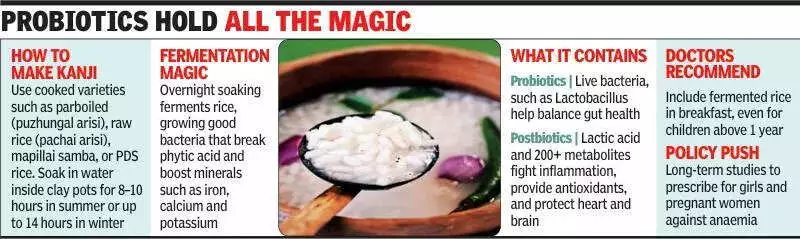
In a significant nod to traditional wisdom, doctors at Chennai's Government Stanley Medical College and Hospital have provided a robust scientific endorsement to the age-old practice of consuming fermented rice porridge, known as pazhaya soru kanji. The hospital, with a history of feeding the poor during the 1780s famine, is now validating the profound health benefits of this humble dish.
Scientific Breakthrough for a Traditional Remedy
Dean of Stanley Hospital, Dr. A. Aravind, highlighted the historical significance, noting the institution was once called the Kanji Thotti Hospital for its famine relief work. Now, it leads research into the science behind the fermented rice. Doctors presented findings showing that cooked rice varieties—including parboiled (puzhungal arisi), raw rice (pachai arisi), mapillai samba, and PDS rice—soaked in clay pots for 8-10 hours in summer and up to 14 in winter, foster beneficial microorganisms.
These microbes include probiotics and postbiotics, which not only aid gut health and help manage conditions like ulcerative colitis and Crohn's disease but also significantly boost daily iron intake. Impressed by the evidence, Health Secretary P. Senthilkumar proposed scaling up the practice to combat anaemia, particularly among adolescent girls and pregnant women.

Lab Findings and Patient Outcomes
Laboratory analysis in 2022 detected probiotic bacteria such as Lactobacillus, Lactococcus lactis, Weisella, and Pediococcus. Researchers also identified over 200 beneficial metabolites with anti-inflammatory, antioxidant, neuroprotective, and cardioprotective properties. "We observed better outcomes in patients who consumed fermented rice. We initiated this research to provide scientific evidence," stated Dr. S. Jeswanth, a surgical gastroenterologist who heads the hospital's stem cell research centre.
Interim results from a study involving 55 patients showed remarkable improvements after six months of consuming the kanji on an empty stomach. Co-author Dr. Secunda Rupert revealed, "At least 13% of patients with severe disease had no symptoms, while moderate cases dropped from 49% to 9%." She added that about 30% of those with irritable bowel disease were cured due to the probiotics and postbiotics in the dish.
The Iron Surge That Caught Policy Makers' Eye
The most striking finding for policymakers was the dramatic increase in iron content. Dr. Jeswanth explained that in 100g of cooked rice, iron measured around 3.4mg. After 12 hours of fermentation, it skyrocketed to 73.91mg—a 21-fold increase. This amount is more than double the daily iron requirement for pregnant women.
The fermentation process improves mineral bioavailability. Lactic acid released during fermentation breaks down phytic acid, an anti-nutrient that inhibits the absorption of iron, calcium, and potassium. An enzyme called phytase, generated in the process, then frees these minerals, leading to significant boosts in iron, calcium (up to 9.23mg/100g), and potassium levels.
Following the revelations, Tamil Nadu Health Minister Ma Subramanian announced the state will explore ways to popularise the dish, even suggesting a dedicated day for fermented rice, similar to practices in Odisha. The minister plans to include the porridge in his own daily breakfast. Doctors across various specialties have also recommended making fermented rice a regular breakfast item for its wide-ranging health benefits.






