

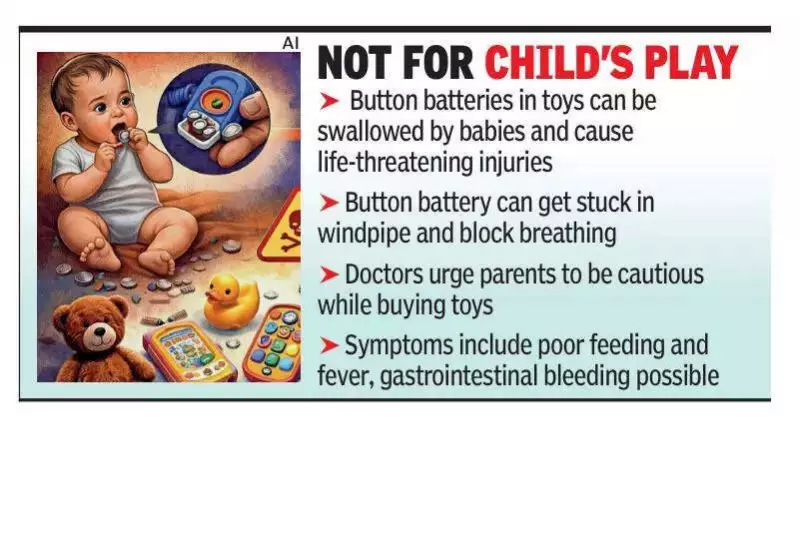
Doctors at Lucknow's Sanjay Gandhi Post Graduate Institute of Medical Sciences (SGPGIMS) have issued a critical warning to parents, highlighting a hidden danger lurking in children's toys. The caution comes after a life-saving surgery on an 18-month-old baby boy who accidentally swallowed a button battery, a common component in many toys, leading to severe, life-threatening injuries.
A Diagnostic Challenge and a Race Against Time
The toddler was brought to SGPGIMS with a troubling 16-day history of refusing food and running a fever. His condition worsened dramatically with two major episodes of bleeding from the upper gastrointestinal tract. With no clear history of the child swallowing any foreign object, diagnosing the problem posed a significant challenge for the medical team.
The child's health deteriorated rapidly as he developed severe anemia from blood loss, requiring multiple blood transfusions. The breakthrough came during an upper gastrointestinal endoscopy, which revealed a foreign object firmly stuck in the upper esophagus. The surrounding tissue showed extensive damage and ulceration.

A chest X-ray then provided a crucial clue, showing the characteristic "halo sign" that often indicates a button battery. To assess the full extent of the damage, doctors performed a CT angiography. The scan confirmed their worst fears: the battery had caused a pseudoaneurysm (a dangerous blood clot) in the left common carotid artery, a major blood vessel supplying the brain, and it was perilously close to the battery.
Complex Surgery to Remove the Hidden Threat
A multi-departmental surgical team, led by Dr. Manjit Kaur and involving experts from paediatric gastroenterology, cardiothoracic and vascular surgery, and radiology, planned a complex operation. During the procedure, they found the 20 mm diameter lithium button battery deeply embedded in the upper esophagus, with inflamed tissue tightly adhered to the carotid artery. The team noted active bleeding at the artery site, which required immediate vascular control.
The battery was first removed endoscopically. Surgeons then performed a major operation to repair the injured section of the artery. To help the child recover and receive nutrition, they also performed additional procedures—a gastrostomy and a feeding jejunostomy.
Recovery and a Vital Safety Message
The child's ordeal was not over post-surgery. He suffered a stroke, leading to weakness on his right side, a consequence of the compromised blood flow to his brain. However, doctors confirmed that the timely surgical intervention prevented far greater damage. On follow-up, the child showed significant neurological improvement and his anatomy was successfully restored.
Presenting this harrowing case as a medical research poster, the SGPGIMS doctors have a clear message for parents. "Toys that bring a smile to a child's face can also become a source of immense pain," they stated. They strongly advise adults to be extremely mindful when purchasing toys, ensuring that small, accessible components like button batteries are secure and out of reach of young children, for whom exploring the world often means putting things in their mouths.






