

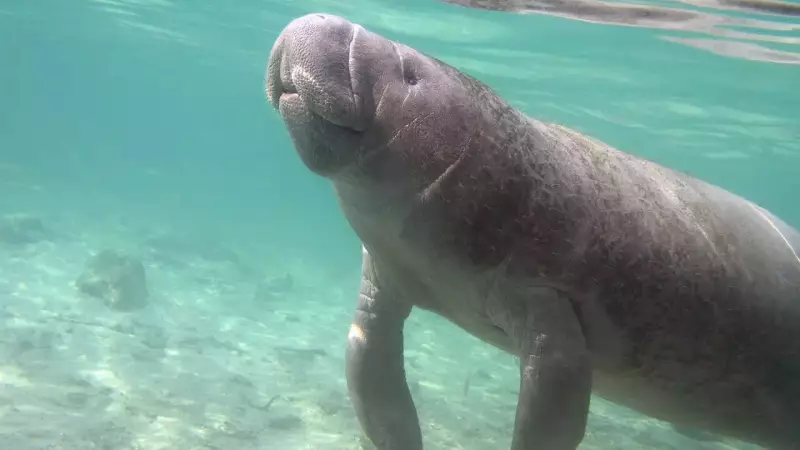
In a remarkable discovery that bridges millions of years, paleontologists have unearthed fossils of a previously unknown species of sea cow in Qatar. These ancient remains, found in shallow coastal rock formations, provide an unprecedented look into the evolutionary history of marine mammals and their enduring connection to vital seagrass ecosystems.
Discovery in the Eastern Tethys Sea
The fossils were extracted from Early Miocene rocks in Qatar, dating back several million years to a period when the region was submerged under the warm waters of the Eastern Tethys Sea. The find includes ribs and a jaw fragment, which together paint a picture of a slow-swimming, bottom-feeding marine mammal. The bone structure is remarkably similar to that of the modern dugong, suggesting a body adapted for grazing on underwater plants in shallow coastal waters.
The concentration of multiple fossils in a small area indicates these ancient sea cows lived in sizeable groups, not as solitary wanderers. This challenges long-held scientific assumptions that prehistoric sea cows were rare and geographically limited. Instead, the evidence points to stable, thriving populations along ancient shorelines.

Ancient Ecosystem Engineers
Research published in the journal Palaeontology and Evolutionary Science positions these ancient creatures as pivotal ecosystem engineers. Their constant grazing on seagrass would have fundamentally shaped their environment, influencing plant growth, sediment stability, and nutrient distribution. This repeated evolutionary pattern, where dugong-like bodies emerged independently in response to similar environmental conditions, underscores the efficiency of this adaptation for life in warm, plant-rich seas.
The study compared the Qatari fossils with sirenian remains from other locations and eras, noting consistent morphological similarities. This convergence highlights how the expansive seagrass meadows of the past drove the evolution of specialized large herbivores.
Lessons for Modern Marine Conservation
This discovery is more than a historical footnote; it offers crucial insights for contemporary conservation. Seagrass meadows are among the ocean's most productive ecosystems, supporting a vast array of marine life. The fossil record now confirms that these habitats have relied on large herbivores like sea cows for their health and stability for millions of years.
The constant grazing prevented the over-accumulation of old plant material, promoted fresh growth, and maintained open patches within the meadows, thereby boosting overall biodiversity. The findings suggest that when such herbivores were abundant, seagrass systems were more resilient.
This historical perspective is vital today as modern seagrass beds face threats from sea warming, coastal development, and declining populations of large marine grazers like dugongs. The evolutionary continuity between the newly discovered species and today's dugongs is striking. Their body plan and feeding habits have remained largely unchanged over eons, proving the success of this niche. However, it also highlights their specialization and vulnerability to habitat disruption.
The fossils from Qatar serve as a powerful reminder of a deep-time relationship between marine mammals and their seagrass homes, offering a lens through which to view and better protect these critical coastal ecosystems for the future.






