Since commencing its full-scale operations in 2020, the All India Institute of Medical Sciences (AIIMS) in Nagpur has witnessed an extraordinary surge in the number of patients seeking treatment. The premier institute has provided outpatient services to more than 24.12 lakh patients and admitted over 98,414 individuals for inpatient care until October 31, 2025.
Operating at Maximum Capacity
The hospital is currently functioning at its absolute limit. With 940 functional beds, including 105 dedicated to intensive care, the general ward bed occupancy hovers near 99%, while ICU beds are consistently full at 100% occupancy. On a typical day, the Outpatient Department (OPD) attends to between 3,500 and 4,000 people, with daily admissions averaging between 100 and 120. The institute recorded its highest single-day OPD footfall of 4,405 patients on September 30, 2024.
The Dual Challenge: High Trust and Staffing Gaps
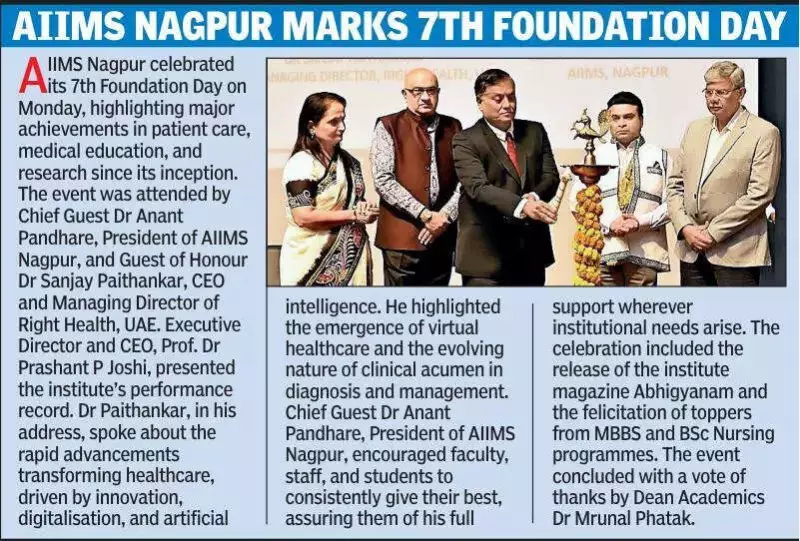
Dr. Prashant Joshi, the Executive Director and CEO of AIIMS-Nagpur, stated that the escalating patient numbers are a testament to the public's faith in the institute. He emphasized that the recruitment process is on a fast track and that there are adequate staff to manage the current load. "Now, we are fully functional with 100% bed occupancy," Dr. Joshi said.

However, official data reveals a contrasting challenge: an acute shortage of medical and support staff is putting a strain on services. Over 30% of posts across faculty, nursing, and non-faculty categories remain unfilled, despite ongoing recruitment drives.
Specifically, out of a sanctioned strength of 800 nursing posts, a majority are vacant. A recent push through the Nursing Officer Recruitment Common Eligibility Test (NORCET-09) has sanctioned 237 nursing officer posts, with recruits expected to join within the next three months. For faculty positions, 116 posts have been advertised and interviews are completed. The filling of non-faculty roles is also in progress through Common Recruitment Exams (CRE-03 and CRE-04).
Expanding Super-Specialty Services and Recognition
Despite staffing hurdles, AIIMS Nagpur has significantly broadened its medical offerings. Dr. Joshi highlighted the institute's advanced work, including 52 kidney transplants, 10 bone marrow transplants, 29 corneal transplants, and 24,882 surgeries performed to date.
The hospital boasts state-of-the-art facilities such as PET scan, MRI, CT, robotic surgery, a sleep lab, and specialized units for diabetic foot analysis and de-addiction. Newly launched services include dedicated transgender healthcare, a paediatric non-communicable disease (NCD) centre, cochlear implants, and robotic-assisted joint replacements.
Its reputation now extends beyond the Vidarbha region, attracting patients from neighbouring states like Madhya Pradesh, Chhattisgarh, Andhra Pradesh, and Telangana. Dr. Joshi added that AIIMS-Nagpur is the first government hospital in the country to provide ID NAT, blood irradiator, and ART facilities. The institute has also earned national acclaim for its robust organ retrieval and donation programmes.
As AIIMS Nagpur continues to serve as a critical healthcare hub for central India, its journey reflects both the high demand for quality public health services and the ongoing need to bridge infrastructure and human resource gaps to sustain this growth.