

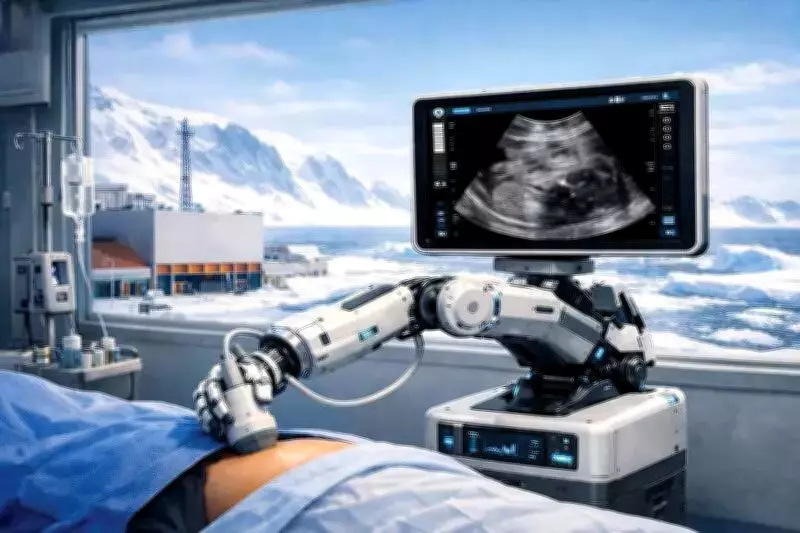
AIIMS Doctors Achieve Breakthrough with Remote Ultrasound in Antarctica
In a groundbreaking demonstration of remote healthcare capabilities, medical specialists at the All India Institute of Medical Sciences (AIIMS) in New Delhi have successfully performed a real-time ultrasound examination on an individual stationed 12,000 kilometers away at India's Maitri research station in Antarctica. This pioneering achievement showcases the potential for delivering emergency medical care in some of the world's most hostile and inaccessible environments.
Addressing Critical Healthcare Gaps in Extreme Environments
The innovative tele-robotic diagnostic system addresses a crucial void in Antarctic healthcare infrastructure and holds significant promise for numerous other challenging locations. Beyond polar regions, this technology is poised to benefit high-altitude areas, offshore platforms, disaster zones, island territories, and rural communities across India where access to specialized medical expertise is limited.
"This represents the first known implementation of such a tele-robotic diagnostic system at an Antarctic research station globally, positioning India at the forefront of medical innovation in polar environments," stated Thamban Meloth, Director of the National Centre for Polar and Ocean Research (NCPOR).

Overcoming Unique Healthcare Challenges in Antarctica
The NCPOR annually dispatches research teams to polar regions and the Himalayas, where scientists and support personnel operate under conditions of extreme cold, prolonged isolation, and constrained medical facilities. While trained medical officers are present at these stations, obtaining specialist consultations from India during emergencies such as trauma, abdominal pain, or suspected internal injuries has historically been severely limited by geographical distance and operational challenges.
"Healthcare delivery in Antarctica remains uniquely challenging," explained Meloth. "Expedition members operate in extreme cold, prolonged isolation, and environments with limited medical infrastructure. While trained medical officers and essential diagnostic equipment are available at stations, access to super-specialist consultation from India can be constrained by geographical distance and operational limitations."
Collaborative Development and Implementation
This technological breakthrough resulted from robust collaboration between multiple institutions including the National Centre for Polar and Ocean Research (NCPOR), AIIMS, IIT Delhi, and various startups. The NCPOR specifically supported the transportation and deployment of the system at Maitri station in Antarctica from their base in Goa.
The system enables doctors in India to conduct ultrasound scans remotely, significantly strengthening rapid diagnosis capabilities and supporting critical decisions regarding potential evacuation of the 25-30 polar scientists and staff stationed at Maitri during Antarctic winters.
Validating Technical Feasibility in Extreme Conditions
"The objectives of the demonstration were to validate technical feasibility under Antarctic conditions and to demonstrate seamless real-time connectivity between AIIMS and Maitri station," said Shailendra Saini, NCPOR Group Director for Antarctic Operations.
The successful demonstration marks a landmark achievement in India's Antarctic program, which has maintained a continuous scientific presence in Antarctica for three decades under the Ministry of Earth Sciences. This technological application builds upon clinical experience gained during the COVID-19 pandemic at AIIMS New Delhi, where tele-robotic ultrasound was previously utilized for imaging COVID-19 patients.
This development represents a significant advancement in telemedicine capabilities, potentially transforming healthcare delivery in some of the world's most remote and challenging environments while establishing India as a leader in polar medical innovation.






