

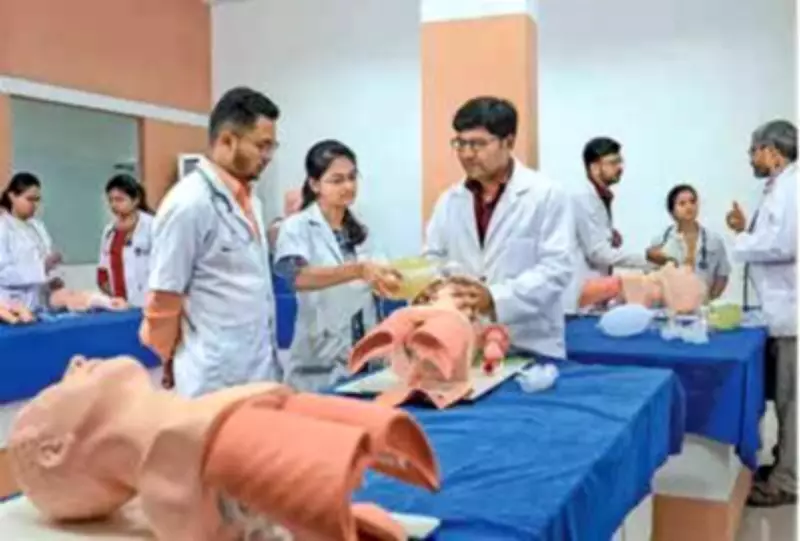
Telangana's Medical Education System Grapples With Severe Faculty Crisis
Hyderabad: As Telangana aggressively expands its network of government medical colleges, a severe faculty shortage has created hollow departments across multiple institutions, sparking urgent concerns about the quality of medical education in the state. A comprehensive survey has uncovered alarming gaps, with 27 departments across 36 government medical colleges operating without any teaching faculty whatsoever.
Survey Exposes Alarming Faculty Deficiencies
The troubling findings emerge from a detailed survey conducted by the Telangana Senior Resident Doctors Association (TSRDA) across government medical colleges in Gadwal, Asifabad, Kodangal, Bhupalpally, and Narayanpet. This crisis has gained significant urgency following inspections by the National Medical Commission (NMC) last year, which flagged deficiencies in 26 of the state's 36 government medical colleges, citing critical gaps in infrastructure, clinical material, and teaching personnel.
According to the TSRDA survey, the faculty crisis extends far beyond isolated vacant positions. More than one in three departments—159 out of 441 surveyed—are functioning without a single professor, the senior-most academic position responsible for curriculum planning, examinations, and postgraduate training. This represents a fundamental breakdown in the academic structure of medical education.

Quantifying the Massive Shortfall
"Across 36 government medical colleges, only 47% of the faculty strength mandated by the National Medical Commission is currently in place, leaving a staggering shortfall of 53%," revealed Dr. D Srinath, president of TSRDA. "Of the 396 departments that responded to our survey, over 150 have no senior faculty whatsoever—neither professors nor associate professors—forcing departments to function under junior staff or remain effectively non-functional."
While older, established institutions such as Osmania Medical College, Gandhi Medical College, and Kakatiya Medical College retain some senior faculty, newer district medical colleges are experiencing the most severe impact. Several colleges have no professors across multiple departments, particularly in foundational subjects like anatomy, physiology, and biochemistry, which form the essential academic base for undergraduate medical education.
The Growing Problem of Single-Faculty Departments
The association has also highlighted a concerning trend of single-faculty departments proliferating across the state. More than 120 departments are reportedly being managed by just one faculty member, typically an assistant professor, with no senior supervision or support structure.
"First-year departments such as anatomy, physiology, and biochemistry are often run by just one assistant professor, a contract faculty member, or even senior residents," explained Dr. Karishni Chittarvu, general secretary of TSRDA. "That single person is expected to manage practicals, theory classes, internal assessments, university exams, seminars, and administrative work—an impossible workload that compromises educational quality."
Falling Short of National Standards
According to NMC norms, a batch of 100 MBBS students requires at least six faculty members: one professor, one associate professor, two assistant professors, and two senior residents. Many Telangana medical colleges are failing to meet this basic benchmark, creating systemic educational deficiencies.
Students report that the faculty shortage is already negatively affecting learning outcomes. A second-year student from Government Medical College, Asifabad, described how the lack of faculty has disrupted early medical training. "In many departments, students are not learning properly. Our curriculum is still pending, and we mostly study previous years' question papers just to pass exams. When we move to clinical practice, it is worrying to think how we will manage with such inadequate foundational training," the student shared.

Root Causes: Rapid Expansion Without Proportional Recruitment
Health experts attribute this crisis to Telangana's rapid expansion of medical colleges without proportionate faculty recruitment. Between 2021 and 2024, the state opened 24 new government medical colleges, but faculty hiring failed to keep pace with this aggressive institutional growth.
Dr. Kiran Madhala, secretary general of the Telangana Teaching Government Doctors Association, noted that poor response to contractual posts has worsened the situation. "The recruitment system virtually collapsed due to poor response to contract posts. At Bhupalpally college, only three doctors applied for nearly 100 contract faculty posts last year, while just three to four doctors joined out of 40 senior resident posts recently allotted," he revealed.
Government Initiatives to Address the Crisis
Director of Medical Education Dr. Narendra Kumar stated that the government is initiating corrective measures, including the 'You Quote, We Pay' program under the National Health Mission, which offers higher consolidated pay for difficult postings. He added that the most critical gap remains at the associate professor level, indicating where recruitment efforts need particular focus.
The faculty shortage crisis in Telangana's medical colleges represents a significant challenge to the state's healthcare education system, with implications for future medical professionals' training and ultimately, the quality of healthcare delivery across the region.





