

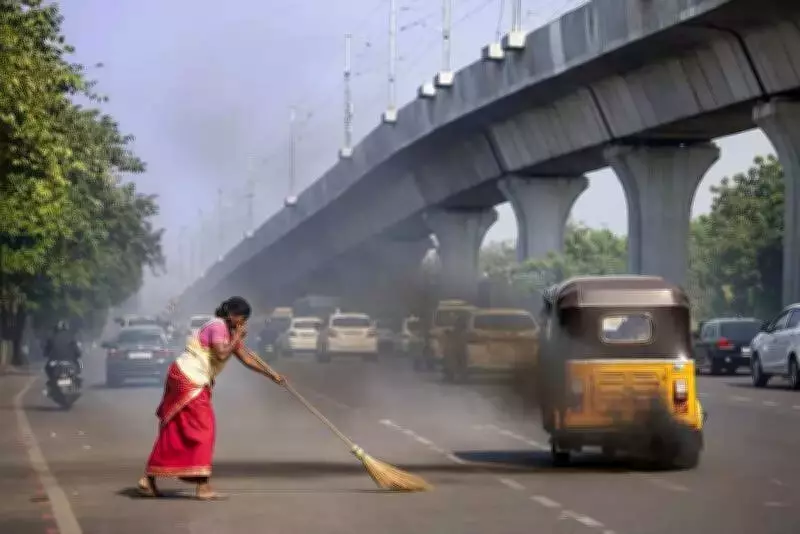
Hyderabad's Vehicular Pollution: A Silent Public Health Emergency
While Hyderabad's air may not yet match the notorious smog of Delhi, a quieter but equally dangerous crisis is unfolding across the city. Vehicular pollution has emerged as the most persistent and significant contributor to deteriorating air quality, transforming traffic congestion from a mere inconvenience into a slow-burning public health emergency.
The Alarming Data Behind the Crisis
Although Hyderabad's Air Quality Index (AQI) typically hovers around 100—seemingly less alarming than Delhi's 300+ or Mumbai's 130—experts warn such comparisons can be dangerously misleading. Multiple datasets reveal that vehicular emissions remain a dominant source of particulate matter pollution. Pollution Control Board measurements show PM2.5 levels ranging from 80 to 140 µg/m³ and PM10 between 70 and 130 µg/m³ across various city pockets. These figures far exceed World Health Organization safety limits of 5 µg/m³ for PM2.5 and 15 µg/m³ for PM10.
A substantial portion of this pollution load originates directly from vehicle exhaust, tyre and brake wear, and prolonged traffic congestion. Environmentalists identify Hyderabad's exploding vehicle population as the core driver, with official estimates placing the city's daily vehicular pollution load at 1,500 tonnes—nearly one-third of total air pollution.

"With more than 88 lakh vehicles on city roads, emissions of particulate matter, nitrogen oxides and sulphur dioxide have become constant rather than episodic phenomena," explained Babu Rao, a senior environmentalist with three decades of air quality experience in Hyderabad.
Worsening Pollution Trends and Invisible Threats
Fresh evidence confirms the pollution burden is intensifying. A Development Data Lab study ranked Hyderabad third among ten Indian cities recording increased PM2.5 concentrations between 2011 and 2022, with levels rising by 15.4%. Only Surat (24.5%) and Pune (32.2%) showed worse trends, while Kozhikode, Kolkata, Chennai and even Delhi recorded declines during the same period.
More concerning is the post-2022 acceleration. Pollution Control Board data compiled by TOI shows PM2.5 concentrations rising to 176 µg/m³ this winter compared to approximately 140 during the same period last year. PM10 climbed to 185 µg/m³, up from nearly 150 in winter 2024. Measured against WHO benchmarks, PM2.5 levels are now up to 35 times higher than guidelines, while PM10 exceeds limits by as much as 37 times.
Traffic congestion not only increases particulate matter but also intensifies gaseous pollutants. Vehicular emissions represent the dominant source of nitrogen dioxide (NO₂), closely linked to respiratory illness and ground-level ozone formation. A report titled 'Beyond North: NO₂ pollution and health risks in seven major Indian cities' found Hyderabad recorded dangerously high NO₂ levels on 307 days in 2023—more than Mumbai, Bengaluru or Kolkata.
Among monitoring stations, Gachibowli recorded the highest average NO₂ concentration at 41 ppb, followed by Old City (23 ppb), Bolarum (22 ppb) and Sanathnagar—all exceeding the WHO's safe limit of 10 ppb.
"Nearly 80% of NO₂ emissions originate from diesel buses, three-wheelers and ageing petrol vehicles," said environmentalist Narsimha Reddy Donthi. He emphasized that chronic traffic idling worsens the situation significantly. "At every signal, thousands of vehicles crawl forward with idling engines emitting carbon monoxide and fine particulates continuously."
Ozone pollution, once confined to industrial belts, has now spread to residential areas. A Centre for Science and Environment report found 10 of Hyderabad's 14 monitoring stations recorded ozone levels beyond WHO limits between January and July 2024. The highest eight-hour average—150.9 µg/m³—was recorded in Sanathnagar, followed by ICRISAT Patancheru and ECIL Kapra.
Mounting Public Health Consequences
Research published in The Lancet Planetary Health reveals the staggering scale of this crisis. The study 'Ambient air pollution and daily mortality in ten cities of India' estimated Hyderabad averaged 5,552 annual deaths due to air pollution between 2008 and 2020. The death toll continues to climb, with 1,597 pollution-related fatalities recorded in 2023 alone.

While updated city-specific health data remains limited, medical professionals report increasing respiratory illness cases. "We are witnessing a rise in asthma and chronic obstructive pulmonary disease cases, often requiring ICU admissions, particularly among elderly and vulnerable populations," said pulmonologist Dr Hari Krishna G. "Long-term exposure to PM2.5 also elevates lung cancer risk even in non-smokers. While not every case can be attributed solely to pollution, the growing burden clearly points to air quality as a major contributing factor."
Implementation Gaps and Proposed Solutions
Despite being classified as a non-attainment city under the National Clean Air Programme, Hyderabad spent only Rs 11.2 crore of its Rs 20 crore allocation in 2024. The city's action plan identified vehicular emissions, road dust and congestion as priority targets, yet implementation remains notably weak.
Ecologist BN Sai Reddy argued that current benchmarks and measures are insufficient. "Even the CPCB's higher thresholds reduce life expectancy. We are treating symptoms rather than addressing core emission sources," he stated, noting that excessive paving and mechanical sweeping may worsen other urban challenges without solving fundamental problems.
Acknowledging these gaps, the Greater Hyderabad Municipal Corporation has constituted a city-level monitoring and implementation committee to recalibrate clean-air strategies.
"We have identified four chronic vehicular pollution corridors—Punjagutta–Patancheru, Charminar–Nampally, Hi-Tec City and MGBS–Secunderabad—and proposed measures including electric buses, expansion of electric three-wheelers, stricter pollution-under-control enforcement and improved construction waste management," explained Raghu Prasad, additional commissioner of GHMC.
However, experts caution that without proper enforcement, plans may remain theoretical. Researchers at the Indian Institute of Technology Delhi stress that Hyderabad must urgently reduce dependence on private vehicles.
"Public transport requires complete overhaul. Non-motorised mobility—walking and cycling—must be prioritized, and vehicle and fuel standards strictly enforced," emphasized Deepti Jain, an air-quality researcher. "Our responses remain largely reactive with advisories and closures rather than preventive. We need to systematically address what adds to pollution today and how vehicular emissions will be controlled over the coming decade."





