Chronic Kidney Disease Epidemic Uncovered in Andhra Pradesh: 60% Affected, 98% Unaware
A recent pilot study conducted by a team of researchers has exposed a severe and largely hidden health crisis in Andhra Pradesh. The findings indicate that chronic kidney disease (CKD) is a major public health issue, particularly among high-risk populations, with alarmingly low awareness levels.
Staggering Prevalence and Awareness Gaps
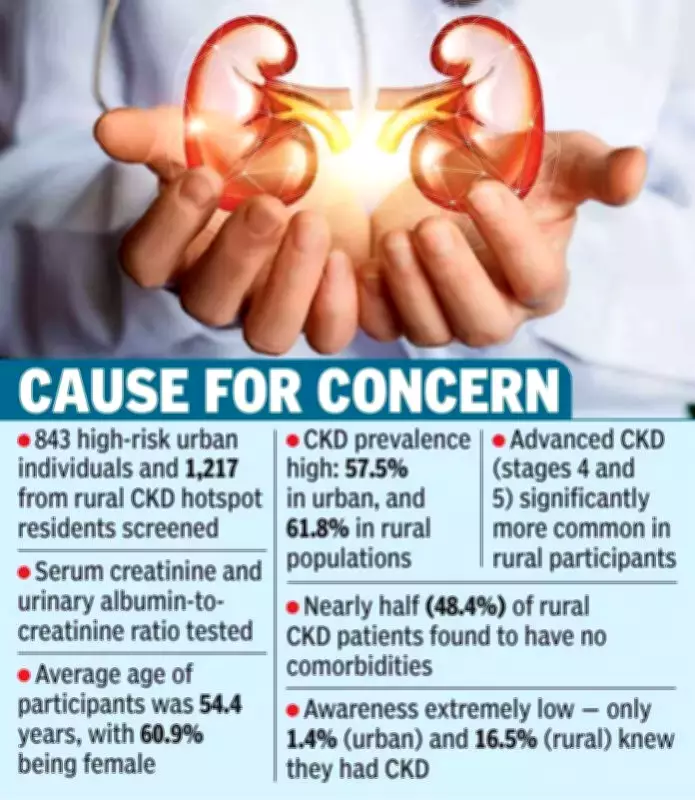
Using point-of-care tests and digital tools in local primary health centres, the researchers screened nearly 2,000 individuals from both urban and rural areas. The results were shocking: CKD was detected in 57.5% of the urban group and 61.8% of the rural group, averaging nearly 60% overall. However, awareness of existing CKD was extremely low. Only 1.4% of urban patients and 16.5% of rural patients knew they had CKD. This means over 98% of urban patients and more than 83% of rural patients were completely unaware of their condition, even when at high or very high risk of complications.
Key Differences Between Urban and Rural Patients
The study revealed significant disparities between urban and rural CKD patients. Advanced CKD stages were more common in rural areas, with 12.5% of patients at stage 4 and 9.8% at stage 5, compared to 4.4% and 1.4% in urban areas. Albuminuria patterns also differed: rural patients exhibited more moderate albuminuria, whereas urban patients had more severe forms.

Urban patients carried a heavier burden of comorbidities, with 80.7% having diabetes and 78.4% hypertension. In contrast, rural patients had lower rates of these conditions. Remarkably, 48.4% of rural CKD patients had no comorbidities, suggesting environmental or unknown causes may be driving the disease in these areas.
Study Methodology and Population Focus
The screening focused on two distinct populations. The first was a high-risk urban group of 843 individuals with non-communicable diseases such as diabetes and hypertension, recruited from primary health centres in Guntur and Mangalagiri. The second was a rural group of 1,217 individuals from CKD hotspot areas in Uddanam (Srikakulam district) and A Konduru (Krishna district). These regions are known for unexplained high CKD prevalence and poor socioeconomic conditions.
Critical Issues and Policy Implications
These results highlight several critical issues. CKD is widespread but largely hidden, even in rural hotspot areas where selective screening had previously been conducted. Economic barriers exacerbate the problem. With only 15% of India's population covered by health insurance and 70% of health costs paid out-of-pocket, routine laboratory testing is unaffordable for many. India's national non-communicable disease program currently covers hypertension and diabetes but not CKD, leaving a major gap in preventive care.
Research Team and Recommendations
The study was conducted by researchers including Rama Krishna Chinta, Venkateswar Shri, Bogdan Milojkovic, Dennis Begos, Shyamala Kemisetti, Naresh Kumar Chintagunti, and Boris Bikbo, representing various medical, healthcare, digital technology, and analytical instrument organisations. It was published in Kidney International Reports, the official journal of the International Society of Nephrology.
The researchers stated: "Our analysis demonstrates the feasibility of using a point-of-care approach for early CKD detection and the capability of an integrated digital mobile solution for disease diagnosis. Importantly, the applied digital solution enables information collection on CKD even by non-specialized but trained workers and supports the integration of kidney care into routine primary health practice. We advocate for wider implementation of CKD screening in high-risk groups and timely referral to predialysis nephrology care, which has been proven to be cost-effective and to reduce complication rates."