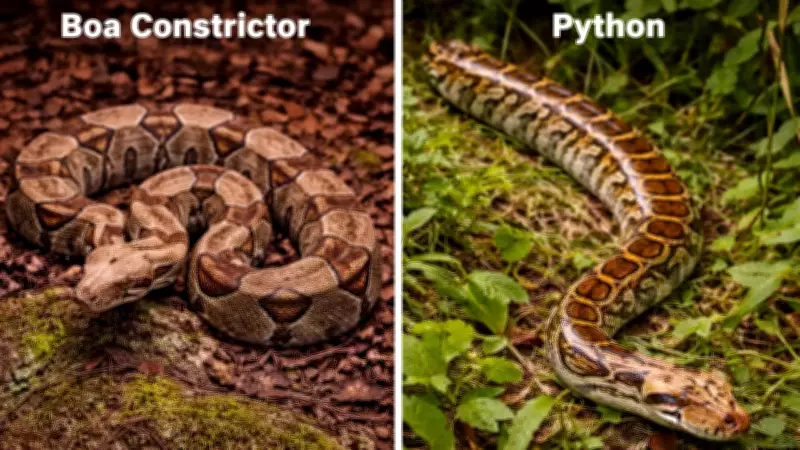
Boa Constrictor vs Python: Unveiling the Key Differences
It is common to mistake the Boa constrictor and the Python due to their similar appearances and shared method of killing prey through constriction. Both are large, non-venomous snakes that rely on squeezing their victims to subdue them. However, despite these surface-level similarities, Boas and Pythons belong to entirely different biological families and exhibit numerous distinctions that go beyond mere biology or behavior. These differences highlight how each species has uniquely adapted to its environment over time.
Size Variations: Boa Constrictor vs Python
One of the most noticeable differences between these two snakes is their size. Boa constrictors typically range from 6 to 10 feet in length, though some individuals may grow slightly longer. In contrast, Pythons show considerable variation depending on the species, with some, like the reticulated python, reaching lengths exceeding 20 feet. While Pythons are generally longer, they tend to be thinner and less muscular compared to the more robust build of Boas. A study titled "Toward a Tree-of-Life for the boas and pythons," published on ScienceDirect, notes that these snake groups have evolved distinct body sizes and morphologies due to divergent evolutionary paths.
Habitat and Geographic Distribution
Another key distinction lies in their habitats. Boa constrictors are primarily found in Central and South America, where they inhabit tropical rainforests and are often seen in trees. On the other hand, Pythons originate from Africa, Asia, and Australia, thriving in diverse environments such as grasslands, forests, and wetlands. Many Python species are adept swimmers and are frequently associated with aquatic habitats, showcasing their adaptability to various terrains.

Reproductive Methods: Live Birth vs Egg Laying
Reproduction offers a clear way to differentiate between Boas and Pythons. Boa constrictors give birth to live young, with offspring developing internally before being born. Research published by the Royal Society in a study called "Evidence for viable, non-clonal but fatherless Boa constrictors" highlights this unique reproductive trait among snakes. Conversely, Pythons lay eggs, with females often coiling around the clutch to protect it from predators and provide warmth for incubation.
Physical and Anatomical Features
While Boas and Pythons may appear structurally similar, there are significant anatomical differences. Pythons possess an extra bone in their skulls and have a higher number of teeth compared to Boas. From an aesthetic perspective, Pythons typically feature elongated, triangular-shaped heads, whereas Boas are more muscular and compact in build.
Behavioral and Locomotive Traits
Both species are proficient constrictors, but their behaviors differ. Boas exhibit a preference for climbing and arboreal lifestyles, especially during their juvenile stages. Pythons, however, tend to remain on the ground and are skilled swimmers, with enhanced locomotive abilities that allow them to navigate diverse landscapes effectively.
Similarities Between Boa Constrictors and Pythons
Despite these differences, Boas and Pythons share several common traits. Both are non-venomous and employ constriction as their primary hunting technique, tightly squeezing prey until it succumbs. Additionally, they possess heat-sensing capabilities, making them efficient nocturnal predators.
Final Verdict on Boa Constrictor vs Python
Although Boa constrictors and Pythons may look alike at first glance, each species is distinct in its own right. From body size and habitat preferences to reproductive methods and anatomical features, these snakes have evolved independently, showcasing the diversity within the reptile world.