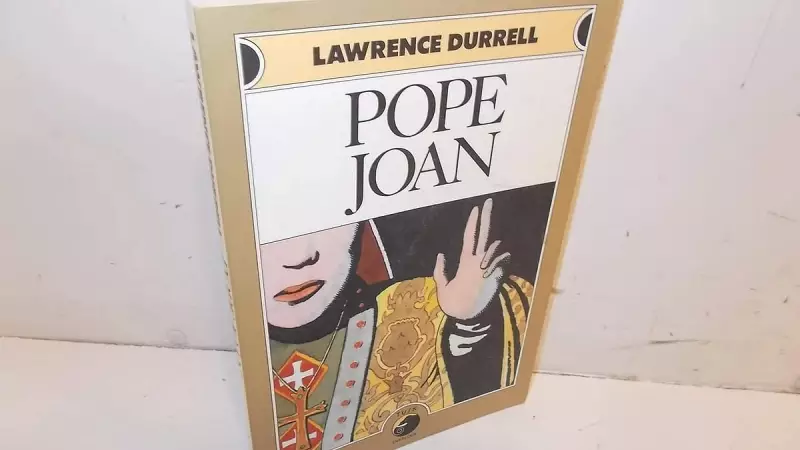
Lawrence Durrell, celebrated author of the Alexandria Quartet, ventured into controversial territory with his novel Pope Joan, creating a work that continues to divide readers and critics decades after its publication. This unconventional take on the medieval legend showcases Durrell's signature literary brilliance while pushing boundaries of taste and propriety.
The Legend Reimagined with Durrell's Flair
Durrell's version of the Pope Joan story transforms the medieval legend into a rich tapestry of historical fiction infused with his distinctive narrative style. The novel follows the extraordinary journey of a woman who disguises herself as a man to rise through the Catholic Church's hierarchy, eventually reaching the papacy itself. Durrell approaches this controversial subject matter with equal parts scholarly insight and irreverent humor.
The author's deep connection to Greek culture and landscape significantly influences the novel's atmosphere and sensibility. Having lived in Greece for many years, Durrell brings an authentic Mediterranean sensibility to the narrative, blending historical facts with imaginative speculation in ways that both educate and entertain readers.

Literary Merit Versus Questionable Taste
What makes Pope Joan particularly fascinating is the tension between its undeniable literary quality and its frequently outrageous content. Durrell demonstrates his masterful command of language and character development throughout the novel, creating vivid scenes and memorable dialogues that showcase why he remains one of the 20th century's most respected English authors.
However, the novel frequently crosses into territory that many readers and critics have labeled as being in bad taste. Durrell doesn't shy away from the more sensational aspects of the Pope Joan legend, including her eventual exposure when she gives birth during a papal procession. These elements are handled with a mixture of historical curiosity and dark humor that some find refreshingly honest and others consider unnecessarily provocative.
Durrell's Unique Narrative Approach
The novel stands out for its sophisticated blending of multiple literary traditions. Durrell combines elements of historical research with psychological insight and philosophical speculation, creating a work that operates on multiple levels simultaneously. Readers encounter not just a retelling of a medieval legend but a meditation on gender, power, religion, and identity.
Durrell's characteristic wit and linguistic playfulness are evident throughout the narrative. He approaches the potentially solemn subject matter with a lightness of touch that prevents the novel from becoming overly didactic or moralizing. Instead, Pope Joan reads as both a serious literary work and an entertainment, a combination that reflects Durrell's broader artistic philosophy.
The novel's reception has been as divided as its content. Some critics praise Durrell's courage in tackling such a controversial subject with intelligence and humor, while others question whether the treatment sometimes crosses from provocative into merely sensational. What remains undeniable is the work's ability to spark discussion and debate among readers, ensuring its continued relevance in literary conversations.
For contemporary readers, Pope Joan offers a fascinating window into both the medieval legend it explores and the mid-20th century literary landscape that produced it. The novel represents an important, if sometimes overlooked, component of Durrell's diverse literary output and continues to challenge and entertain new generations of readers discovering his work.