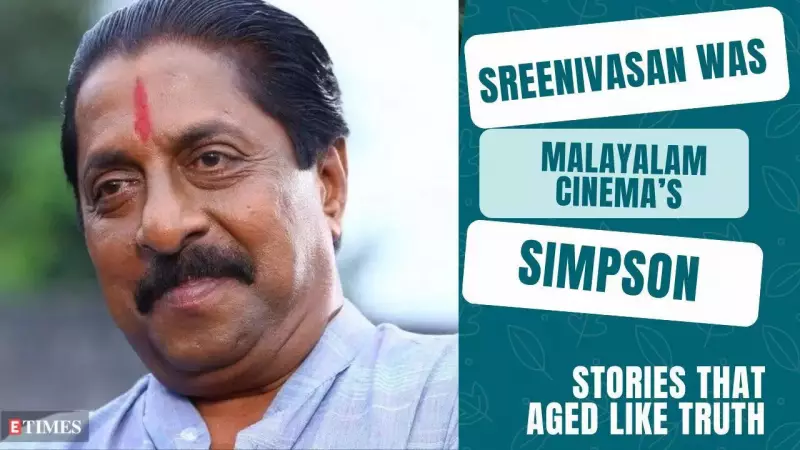
In the world of Malayalam cinema, the late writer and actor Sreenivasan was often described as the sharpest mirror of society. His work did not rely on magical foresight to predict the future. Instead, it delved into the core truths of human behavior, power dynamics, and social structures. By understanding how people think and how systems operate, Sreenivasan crafted narratives that repeatedly echoed in real life, making his films timeless chronicles of Malayali experience.
The Prophetic Satire of Power and Politics
Sreenivasan's genius lay in his acute observation of power. His 1998 film 'Ayaal Kadhayezhuthukayanu' presented a now-iconic scene: a chair dispute in a government office where two officers claim authority. In late 2024, an almost identical incident unfolded at the District Medical Office in Kozhikode, proving the unsettling accuracy of his satire. The fictional comedy had turned into a real-life documentary of unchanging bureaucratic turf wars.
His 1991 political satire 'Sandesham' explored how partisan politics could fracture a family from within. The film depicted two brothers supporting rival parties, leading to fake protests, false cases, and moral decay within their home. Over three decades later, the film's relevance has not faded. Kerala's political landscape continues to be marked by intense rivalries, scandals, and divisions that resonate deeply with the film's narrative. During every election season, dialogues from 'Sandesham' trend online, a testament to Sreenivasan's precise understanding of political extremism.

Capturing Economic Dreams and Disillusionment
Sreenivasan also had a firm grasp on the socio-economic aspirations of Malayalis. The 1989 film 'Varavelpu', starring Mohanlal, told the story of a Gulf returnee dreaming of starting a business, only to be crushed by corruption, union issues, and endless procedural hurdles. The film highlighted the painful reality faced by thousands of Non-Resident Indians (NRIs). Today, returnees still grapple with red tape, political pressure, and shattered dreams, a struggle Sreenivasan portrayed long before it entered mainstream discourse.
The issue of unemployment and migration was brilliantly captured in the 1987 classic 'Nadodikkattu' and its sequels. Through the hilarious yet tragic journey of two educated but jobless men chasing Gulf dreams, the film mirrored the desperation of Kerala's youth. It shed light on the mass migration phenomenon that has shaped the state's demographics and economy for generations, a reality that persists to this day.
Exposing the Inner Workings of Institutions
Beyond politics and society, Sreenivasan turned his incisive gaze inward to the film industry itself. His 2005 meta-cinematic venture 'Udayananu Tharam' laid bare the ugly truths of Mollywood: clashing egos, manufactured stardom, plagiarism, and ruthless power games. Years after its release, real-world debates and controversies within the industry have consistently validated the film's satirical take, proving its sharp commentary on systemic inequality and control.
As filmmaker Rahul Riji Nair, director of 'Keedam', expressed in an exclusive interview with ETimes, Sreenivasan was the epitome of dedication. "I had only spent 10 days with him and those 10 days are the biggest achievement in my life. I consider him as the GOAT in cinema," Nair stated, highlighting the profound impact of the writer-actor's work ethic and insight.
Sreenivasan did not possess a crystal ball. His 'predictions' were born from a deep and empathetic understanding of people, power, and the patterns in which societies repeat their mistakes. This profound insight is what makes his body of work not just comedies or dramas, but evergreen social documents that continue to reflect, and often foreshadow, the realities of life in Kerala.