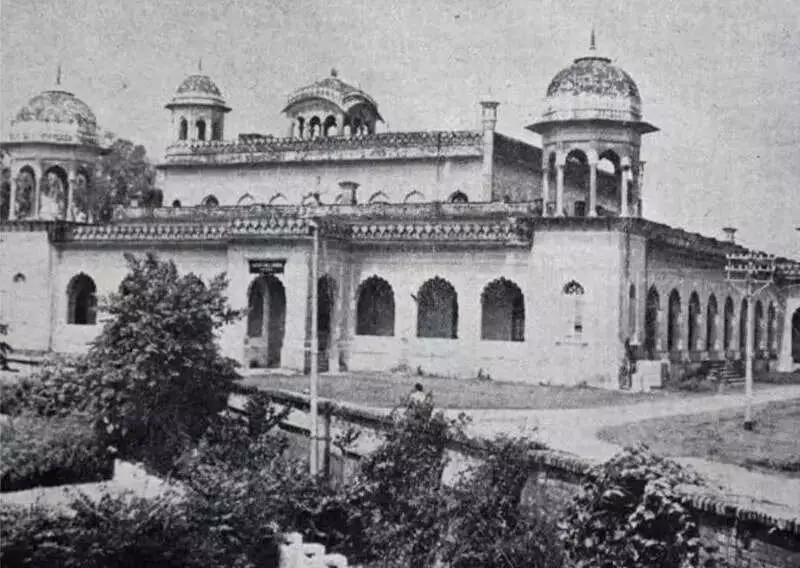
One of India's most prestigious music universities, Bhatkhande Sanskriti Vishwavidyalaya in Lucknow, is set to embark on a year-long celebration marking its 100-year journey. The institution's remarkable century traces its genesis directly to a landmark event: the fourth All India Music Conference held in Lucknow from January 9 to 16, 1925.
The Historic Conference That Started It All
In the chilly winter of 1924, invitations were dispatched across the country. Eminent musicologists and legendary artists were asked to confirm their participation by mid-December for this grand conference scheduled for the following month. The event, as documented in the official 'Report of the Fourth All India Music Conference Lucknow, Volume 1' (printed at Taluqdar Press in 1925), proved to be a watershed moment for Indian classical music.
The conference's general secretary, Rai Umanath Bali, a key patron and educationist, captured its significance in the report's foreword. He described it as not just "a galaxy of musical talent" drawn to Lucknow from across India, but also the birthplace of an "epoch-making event"—the decision to found a College of Music for the provinces.

Bali credited earlier music conferences for building public opinion to systematize the study of Indian music. When the proposal for a well-equipped college was raised at the 1925 gathering, the response was overwhelmingly positive. Donations totaling Rs 42,000 were announced on the spot. Demonstrating his practical support, His Excellency Sir William Marris, KCSI, KCIE, the Governor of the United Provinces, led the subscription list.
From Resolution to Reality: The Birth of Marris College
A formal resolution to establish an All India College of Music was passed during the conference, which was presided over by Governor Sir William Sinclair Marris. This resolution set in motion the creation of the Marris College of Hindustani Music, established in 1926.
The driving force behind this institutionalization was the legendary musicologist Pandit Vishnu Narayan Bhatkhande. With the crucial cooperation of Rai Umanath Bali, Rai Rajeshwar Bali, and other Lucknow-based patrons and connoisseurs, Bhatkhande established the music school in the culturally rich princely state of Awadh.
University Vice-Chancellor, Prof. Mandavi Singh, contextualized this development. She explained that the British rulers introduced the modern, graded, and time-bound system of institutional education from the mid-19th century. Indian music education was integrated into this framework at the start of the 20th century, largely through the parallel efforts of two stalwarts: Pandit Vishnu Digambar Paluskar and Pandit Vishnu Narayan Bhatkhande.
A Century of Nurturing Musical Legends
What began as the Marris College is known today as Bhatkhande Sanskriti Vishwavidyalaya. Over its 100-year journey, the institution has been a crucible for extraordinary talent, shaping the careers of countless artists who went on to define Indian music.
Among its most illustrious alumni are the legendary film music composer Naushad and the revered "king of ghazals," the noted singer Talat Mahmood. The university's legacy is a testament to its foundational mission of organizing and systematizing Indian musical education, a mission born from that historic conference a century ago.
As the university prepares to commence its centenary celebrations, it not only honors its own history but also the visionary collaboration of artists, scholars, and patrons who, in the winter of 1924-25, laid the cornerstone for a formal institution that would preserve and propagate India's rich musical heritage for generations to come.