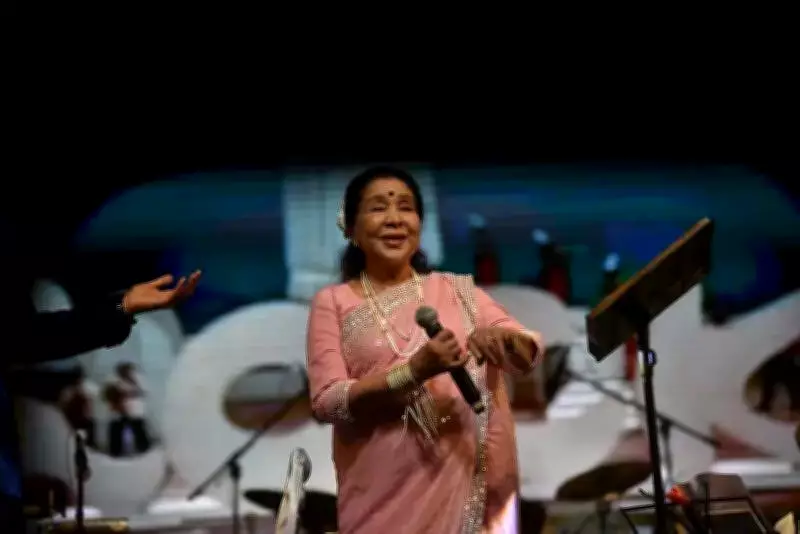
Kerala's Music World Grieves the Loss of Legendary Playback Singer Asha Bhosle
A profound wave of sorrow has enveloped Kerala's vibrant music circles following the passing of the iconic playback singer Asha Bhosle on Sunday. Tributes have been flowing continuously from fellow artists, critics, and countless fans, all mourning the loss of a true musical giant whose voice defined generations.
An Extraordinary Career with a Singular Malayalam Contribution
Asha Bhosle, celebrated globally for her remarkable versatility and vocal range, recorded an astonishing repertoire of over 12,000 songs across numerous Indian languages throughout her illustrious career. However, her direct contribution to the Malayalam film industry remains uniquely confined to just one song, which has nevertheless achieved legendary status and enduring popularity over the decades.
Esteemed music critic Ravi Menon provided detailed insights, recalling that Bhosle's sole Malayalam track was the beautiful composition 'Swayamvara Shubhadina Mangalangal', crafted by the renowned composer Ravindra Jain for the 1977 film Sujatha. "Director Hariharan, along with the legendary singer K J Yesudas and other key figures, strongly believed that Asha Bhosle's distinctive voice would be perfectly suited for this particular composition. The recording session itself took place in a studio located in Bombay," Menon explained.

The Challenges of Singing in Malayalam and a Missed Opportunity
During a memorable event hosted by a prominent Malayalam television channel, Asha Bhosle herself had openly discussed the significant challenges she encountered while attempting to sing in the Malayalam language. She vividly recalled moments where she had to pause at specific words, such as 'priya thozhi', acknowledging the inherent complexity and unique phonetic structure of the language.
"Malayalam is distinctly different; it is not Tamil, Telugu, or any other Indian language I had previously experienced. When I finally completed the song, I felt an immense sense of happiness and accomplishment for having successfully sung in such a difficult language. Initially, I was quite apprehensive, but afterwards, I genuinely wished I could have sung more songs in Malayalam," Bhosle had expressed during that interview, highlighting a poignant regret about not exploring the language further.
A Wedding Anthem and Collaborative Memories
Ravi Menon emphasized that the song quickly became a massive hit upon its release, evolving into a staple melody frequently played at wedding ceremonies and festive occasions across Kerala. "From that point onward, she never sang for another Malayalam film, despite collaborating extensively with numerous talented singers from Kerala on other projects. For instance, she performed a beautiful duet with K J Yesudas in one of his earlier hit songs, 'Jaaneman Jaaneman Tere Do Nain'. She also collaborated with the acclaimed singer Madhu Balakrishnan for the song 'Konja Neram' in the 2005 Tamil film Chandramukhi," Menon added, illustrating her broader connections with South Indian music.
Madhu Balakrishnan shared a fascinating anecdote with The Times of India, revealing that he was initially unaware of who had sung the female portion of their duet. "When I arrived at the studio for the recording, they played the female vocal track and asked me to guess the singer. My first thought was that it might be the legendary S. Janaki, but I soon realized with astonishment that it was none other than Asha Ji herself," Balakrishnan recounted.
He further expressed his deep admiration for Bhosle's unparalleled legacy, stating, "Asha Ji occupies a position in music comparable to what Sachin Tendulkar represents in cricket; she is undoubtedly one of the greatest singers of all time, whose influence transcends boundaries and generations."
Historical Context and Lasting Musical Impact
Reflecting on the broader historical context, Ravi Menon noted that when Asha Bhosle began her singing career in 1943, the Malayalam cinema industry was still in its nascent stages of development. During that era, Hindi film songs, including many timeless classics sung by Bhosle herself, overwhelmingly dominated the musical preferences and listening habits of music lovers throughout Kerala.

This single Malayalam song, therefore, stands as a rare and precious bridge between her monumental Hindi film career and the rich cultural tapestry of Kerala's cinematic music. Its continued popularity at weddings and cultural events serves as a testament to her extraordinary talent and the lasting emotional resonance she created, even with minimal direct involvement in the language. The music community in Kerala, while grieving her loss, continues to celebrate this unique contribution that has become an indelible part of the region's musical heritage.